
NatHERS for Existing Homes & Star Ratings
Find out how an existing-home energy assessment works, where an attached garage door may fit, and why documented assembly R-values give your assessor better information to consider.
The Standard for Garage Door Thermal Performance in Australia
Engineered composite insulation. Independently verified R-values. Built specifically for the mechanics of your garage door.
Est. 2012
Australia's Original System
Verified R-Values
R1.43 Winter / R1.39 Summer

Australian Made
Licence 7177
Lightweight
About 7kg - Double Door
Composite Technology
Purpose Built for Garage Doors
15 Year Warranty
Complete ThermaDoor Panel System
NatHERS for existing homes helps Australian homeowners understand how an already-built home performs and which upgrades may improve comfort and energy use. Star ratings for existing homes are determined from the whole property, including its construction, orientation, insulation, glazing, heating and cooling, and appliances. Garage door insulation for existing home energy ratings may be relevant where the garage is attached to the house, sits below bedrooms or adjoins living areas. ThermaDoor provides documented R1.43 winter and R1.39 summer installed assembly values for an assessor to consider; the assessor decides whether and how that information is relevant to the assessment of your home.
NatHERS for Existing Homes: What the Assessment Looks At
If you are building a new home or undertaking a major renovation? See our guide to garage door insulation for new homes and NatHERS assessments.

Star Ratings for Existing Homes: What They Do and Do Not Measure
Why a Documented Garage-Door Assembly R-Value Matters
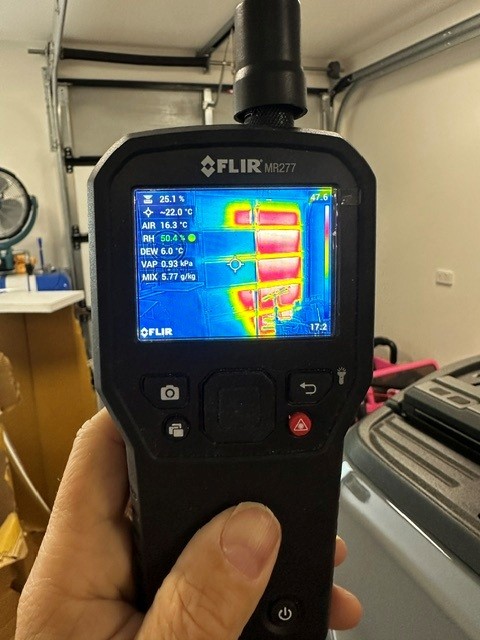
Selling or Renting an Existing Home: Document Your Upgrades

Estimate Energy Savings: Garage Door Insulation for Existing Homes
Step 1: Where are you located?
Your climate affects how much thermal load your garage door creates and how much insulation can help.
Step 2: What size is your garage door?
Larger doors have more surface area, so insulation has a greater impact on thermal load.
Step 3: Tell us about your home
These factors determine how much the garage door's thermal performance affects your living spaces and energy use.
Your electricity rate
Your results are ready
Based on your inputs
Thermal performance — before & after
Without ThermaDoor
R0.0
Uninsulated steel door
No thermal resistance
ThermaDoor
R1.43
Winter assembly R-value
R1.39 summer
AS/NZS 4859.1 & 4859.2:2018
What ThermaDoor does for your door
Estimated annual energy saving
$250 – $450
Typical estimate · per year
Kit cost (DIY)
—
Typical payback
—
10-yr return
—
Calculated for ThermaDoor only — Australia's original purpose-made, independently tested garage door insulation
Conservative
$120 – $250
per year
Typical
$250 – $450
per year
High Usage
$450 – $700+
per year
Return on investment — based on your DIY kit price
| Scenario | Annual saving | Payback | 10-yr saving |
|---|
Kit from $330 inc. GST. Freight additional — calculated at checkout.
Your inputs
Frequently Asked Questions: NatHERS, Star Ratings and Existing Homes
Is NatHERS available for existing homes?
Yes. NatHERS has been expanded to offer energy ratings for existing homes. An assessment helps homeowners understand their home’s current energy performance and identify improvements that may improve comfort and reduce energy use and costs.
What are Star Ratings for existing homes?
A Star Rating is part of the wider energy-performance picture for a home. It reflects the home as a whole, not one product in isolation. The result depends on the property’s construction, orientation, insulation, glazing, heating and cooling, appliances, and the applicable assessment process.
Does ThermaDoor affect my Home Energy Rating?
A documented garage-door assembly R-value may be useful information for an accredited assessor if the garage-door construction is relevant to your existing home’s assessment. ThermaDoor’s R1.43 winter and R1.39 summer figures relate to a defined installed garage-door assembly. They do not guarantee a particular Home Energy Rating or Star Rating because an existing-home assessment considers the whole dwelling and its current features. Ask your assessor how the garage-door information may be used for your home.
Can garage door insulation improve Star Ratings for existing homes?
An insulated garage door may be relevant where the garage is attached to or affects adjoining parts of the home. However, no individual product can promise a particular Star Rating. Give your assessor the documented garage-door assembly information so they can decide whether it is relevant to your assessment.
What information should I give an existing-home assessor?
Explain how the garage connects to the home, including whether it shares walls with living areas, sits below bedrooms or is used regularly as a workshop or recreation space. Provide the product specification and the independent thermal-performance calculation for the installed garage-door assembly. Your assessor can determine whether that information is relevant to the assessment.
Can I add insulation to my existing garage door?
Yes. ThermaDoor is designed for retrofit installation on suitable sectional and tilt garage doors. The panels fit within the existing door sections without adhesives or permanent changes to the door. Check your door type and dimensions before ordering, and follow the installation instructions.
Will ThermaDoor work with my garage door?
ThermaDoor suits many standard sectional and tilt garage doors. Suitability depends on the door type, panel dimensions, available space and condition of the door. Send a photo and measurements to ThermaDoor if you would like confirmation before ordering.
What R-value does ThermaDoor provide?
ThermaDoor has documented R1.43 winter and R1.39 summer values for a defined installed garage-door assembly. These values describe the completed system, including the insulation panels, steel skins, hinges, joins and panel edges, rather than the insulation panel alone. The supporting document is an independent engineering calculation prepared under AS/NZS 4859.1:2018 and AS/NZS 4859.2:2018.
How much could I save on energy bills?
Savings depend on your local climate, garage-door size, orientation, home construction, air leakage, electricity tariff, heating and cooling use, and how the garage connects to adjoining rooms. Use the calculator on this page for an indicative estimate. The calculator is not a NatHERS assessment, Home Energy Rating or Star Rating and does not guarantee energy savings or payback.
Is ThermaDoor a DIY product?
Yes. ThermaDoor is available as a DIY kit for suitable sectional and tilt doors. Written instructions and installation videos are available. A professional supply-and-install service is also available in selected areas if you prefer assistance.
Where can I buy ThermaDoor?
ThermaDoor is available directly from thermadoor.com.au and through authorised distributors across Australia. Use the distributor locator or contact ThermaDoor to find the best purchasing option for your location.
How long does installation take?
Installation time varies with door size, type and condition. A standard single sectional door can commonly be completed by a prepared DIY installer in a few hours. Allow extra time to measure correctly, follow the instructions and check the door operates smoothly after installation.
Make your garage a more comfortable space all year round.
Get exact DIY pricing online or find professional installation near you.
DIY kits ship Australia-wide · Professional installation available through authorised distributors