Garage Door Insulation for New Home Energy Ratings

The only garage door insulation in Australia with verified assembly R-values for NatHERS, BASIX and BESS assessments — backed by an independent engineering report.

Home / Garage Door Insulation and Home Energy Rating / Home Energy Rating — New Homes & Renovations

The 7-Star NatHERS Minimum — Why the Garage Door Matters in New Home Energy Ratings
Across Australia, new homes and units may be required to meet NCC residential energy efficiency requirements, including a minimum 7-star NatHERS thermal energy rating where adopted and applicable. Some major renovations, extensions and alterations may also need to comply. Insulating an attached garage door with a purpose-made, verified product can help improve the home’s thermal performance and may contribute to achieving a higher energy rating, particularly where the garage is air-conditioned or otherwise conditioned. 
 
This rating is calculated at the design stage by an accredited energy assessor using approved software, and it measures the thermal performance of the building fabric — floors, walls, windows, roof and doors.
 
Every element entered into the assessment contributes to the final Star Rating outcome. The garage door is one of the largest moving panels in the building envelope, yet it is frequently overlooked or entered using a default value rather than verified product-specific data.
 
Where the garage is attached to the home, positioned below occupied rooms, or shares walls with internal living spaces, the thermal performance of the garage door is directly relevant to the assessment. Specifying a product with a verified complete installed garage door assembly R-value gives the assessor accurate data to work with — rather than an assumption.
 
ThermaDoor provides independently verified assembly R-values of R1.43 winter and R1.39 summer, tested under AS/NZS 4859.1:2018 and AS/NZS 4859.2:2018. These figures apply to the complete installed garage door assembly, not the insulation material alone.
 
Already own your home? See the Existing Homes page instead.
 
 
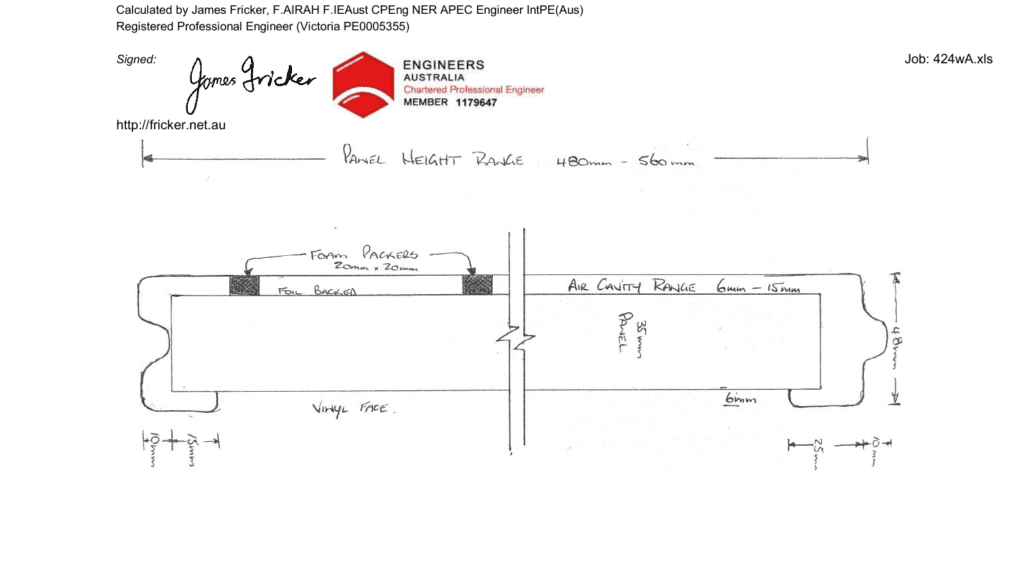
ThermaDoor garage door insulation assembly diagram — independent NatHERS assessment engineering report showing R-value calculation to AS/NZS 4859.2:2018 by James M Fricker, Chartered Professional Engineer
James Fricker engineering diagram showing ThermaDoor garage door insulation assembly cross-section for NatHERS assessment

Why the Garage Door Gets Left Out of NatHERS Assessments

In most NatHERS assessments, the garage door is either omitted entirely or entered using a generic default value. This happens for one reason: most garage door insulation products do not provide the data an assessor needs.
 
An assessor requires a verified complete installed garage door assembly R-value to enter the door accurately as a custom input in their accredited software. What most products provide — if anything — is a material R-value: a figure that measures only the insulation panel in isolation, without accounting for the steel skins, hinges, joins, panel edges, tracks and air gaps that make up the real door assembly.
 
These steel components conduct heat. They create thermal bridging — pathways that allow heat to bypass the insulation and move through the door. A material-only R-value does not account for this, which means it does not accurately represent how the door performs once installed.
 
ThermaDoor’s assembly R-values of R1.43 winter and R1.39 summer are calculated for the complete installed garage door assembly under AS/NZS 4859.1:2018 and AS/NZS 4859.2:2018 — the same Australian Standards used for wall and ceiling insulation testing. This gives assessors a verified, defensible figure they can use with confidence.
Thermal Bridging Through Steel Garage Door Hardware — FLIR Thermal Image
FLIR thermal image showing heat loss through garage door hinges and joins — thermal bridging in an uninsulated garage door assembly

Garage Door Insulation for NatHERS Assessors, Builders and Designers

Specifying ThermaDoor garage door insulation gives builders, designers and energy assessors a clear documentation pathway for NatHERS assessments and new home energy ratings. Instead of treating the garage door as an unknown surface, a generic insulation item or an unsupported product claim, ThermaDoor provides product-specific information that can be reviewed as part of a broader Home Energy Rating, NatHERS, renovation or new-build discussion.
 
ThermaDoor’s verified complete installed garage door assembly R-values of R1.43 winter and R1.39 summer apply to the installed garage door assembly, not the insulation material alone. This distinction can be useful where the garage is attached to the home, positioned below living areas, shares walls with occupied rooms or may otherwise influence the thermal performance discussion.
 
Where ThermaDoor is intended for a project, it should be identified by name in plans, specifications and project documentation. This helps builders, designers and assessors distinguish ThermaDoor from generic products, material-only claims or products without verified installed assembly data, and ensures the correct product information is available when garage door insulation is being considered.

How ThermaDoor Is Specified in a New Home or Renovation

For Builders, Designers, Architects and NatHERS Assessors

ThermaDoor’s verified assembly R-values of R1.43 winter and R1.39 summer are available for use as custom inputs in accredited NatHERS software — replacing the value that would otherwise be applied to the garage door in the assessment.
 
The ThermaDoor Thermal Performance Report provides the complete installed assembly R-values, calculated under AS/NZS 4859.1:2018 and AS/NZS 4859.2:2018 by James M Fricker, Registered Professional Engineer (Victoria PE0005355). Where ThermaDoor is intended for a project, it should be identified by name in plans, specifications and project documentation.
 

For Homeowners Building a New Home

If you are building a new home or undertaking a major renovation, the garage door is entered into the NatHERS energy assessment at the design stage — typically by your builder, designer or assessor.
 
Asking your builder to specify ThermaDoor by name ensures that the garage door is entered into the assessment using ThermaDoor’s verified assembly R-value data, rather than a value that may not reflect the product being installed. It is a straightforward specification decision that gives your home a more accurate energy rating from the outset.

NatHERS Garage Door Insulation — New Homes FAQ

Does the garage door need to be included in a NatHERS assessment?

If the garage is attached to the home, positioned below occupied rooms, or shares walls with internal living spaces, the garage door is part of the building envelope and should be included in the assessment. In these situations, the thermal performance of the garage door directly affects the star rating outcome.

ThermaDoor has a verified complete installed garage door assembly R-value of R1.43 winter and R1.39 summer. These figures apply to the full installed assembly — including steel skins, hinges, joins and panel edges — not the insulation material alone. They are calculated under AS/NZS 4859.1:2018 and AS/NZS 4859.2:2018 by James M Fricker, Registered Professional Engineer (Victoria PE0005355).

Yes. ThermaDoor’s verified assembly R-values can be entered as a custom garage door input in accredited NatHERS software. The ThermaDoor Thermal Performance Report provides the data required for this input.

A material R-value measures the thermal resistance of the insulation panel alone. An assembly R-value measures the thermal resistance of the complete installed door — including the steel components that conduct heat and create thermal bridging. For NatHERS assessment purposes, the assembly R-value is the relevant figure.

Using a verified assembly R-value that accurately reflects the installed product gives the assessor more accurate data to work with. Whether this affects the final star rating depends on the overall design of the home, the size and orientation of the garage, and how the garage relates to the rest of the building envelope. ThermaDoor does not make star rating claims — it provides verified data that supports an accurate assessment.

Yes. ThermaDoor is suitable for both new home builds and major renovations where a NatHERS assessment is required. It can be specified at the design stage and identified by name in plans, specifications and project documentation.

The report is available to download from the ThermaDoor website. It contains the verified assembly R-values, testing methodology, and engineering credentials required for NatHERS assessment purposes.

Make your garage a more comfortable space all year round.

Get exact DIY pricing online or find professional installation near you.

DIY kits ship Australia-wide · Professional installation available through authorised distributors

DIY Kit Pricing Guide

The prices below are a guide only. For your exact price including freight to your door, grab a tape measure and use our shop — it takes two minutes, no account needed, and you’ll know exactly what you’re up for before you commit to a thing.

Door Size Panels Price (from)
Single Door8 panelsFrom $330
Single Door (Large)10 panelsFrom $380
Double Door16 panelsFrom $660
Double Door (Large)20 panelsFrom $760

* Prices include GST. Freight not included — calculated at checkout based on your postcode. No obligation to buy.

Most DIYers grab a tape measure and have their exact price in just a couple of minutes

Not ready to measure up just yet? Fill in our enquiry form  — allow a few days during busy periods.

ThermaDoor Installation

Let our experts handle installation for you
Or Ask Us A Question

Call or send an enquiry below to see if we have an installer in your area.

Make an Enquiry