Home Energy Rating & ThermaDoor Garage Door Insulation

ThermaDoor provides verified assembly R-values for use in NatHERS assessments and home energy ratings — supporting accurate thermal modelling for garages attached to or adjoining living areas.

Home / Garage Door Insulation and Home Energy Rating
As Home Energy Rating and NatHERS conversations become more common in Australian homes, the garage door deserves closer attention. In attached homes, homes with rooms above the garage, or garages connected to internal living areas, the garage door can form a large moving surface that affects heat transfer, comfort and how the space is discussed during renovation or specification planning.
 
ThermaDoor garage door insulation gives homeowners, builders, designers and assessors a clearer way to discuss this part of the home. It is purpose-made for suitable sectional and tilt garage doors, supported by verified complete installed garage door assembly R-values of R1.43 winter and R1.39 summer, and backed by product documentation that can be referenced when ThermaDoor is intended for a project.

What is ThermaDoor Garage Door Insulation

ThermaDoor garage door insulation is a purpose-made panel system designed for suitable sectional and tilt garage doors. The panels are fitted to the inside of the garage door to help reduce heat transfer through the door while allowing the door to continue operating normally.
 
Unlike general-purpose insulation materials, ThermaDoor is designed specifically for the garage door environment, where the door moves, flexes and includes metal sections, joins and hardware. This is why product design, installation method and tested assembly performance all matter.
Exploded diagram of ThermaDoor garage door insulation panel showing UV-Stable Laminated Vinyl Facing, High-Density EPS Core, and Laminated Sisalation Foil Backing
ThermaDoor’s tri-layer panel construction is designed specifically for suitable sectional and tilt garage doors.

Why the Garage Door Can Matter in Home Energy Rating Discussions

A Home Energy Rating looks at the home as a connected building, not as a collection of isolated products. For that reason, the garage door can be worth considering where the garage is attached to the home, sits below occupied rooms or forms part of the household’s everyday entry, storage or working space.
 
In many Australian homes, the garage door is one of the largest moving surfaces connected to the building. If it is uninsulated, it can contribute to unwanted heat gain in summer and heat loss in winter, particularly where the garage is closely linked to internal rooms or frequently used areas.
 
The practical question is not whether one product can determine a rating outcome. It is whether the garage door has been considered properly, with clear product information and credible performance data, when comfort, renovation planning or energy-performance discussions are taking place.

ThermaDoor in Home Energy Assessments

In energy assessment, renovation and specification discussions, ThermaDoor helps the garage door be treated as a documented building element rather than a vague product choice. This is especially useful when the garage is connected to parts of the home that influence comfort or thermal performance.
 
For assessors, designers and builders, the value is clarity. ThermaDoor provides product-specific information that can be reviewed alongside the rest of the project documentation, helping the garage door be discussed on the basis of evidence rather than assumptions.
Installed ThermaDoor garage door insulation panels
Installed ThermaDoor garage door insulation panels in a suitable sectional garage door.

Verified Complete Installed Garage Door Assembly R-Values

 
A key difference with ThermaDoor garage door insulation is that its R-value claims are not based on insulation material alone. Garage doors are moving assemblies made up of panels, metal skins, hinges, joins, tracks and operating hardware. These parts can all affect thermal performance, which is why a material-only R-value does not properly describe how an insulated garage door performs once installed.
 
ThermaDoor has verified complete installed garage door assembly R-values of R1.43 winter and R1.39 summer, tested under AS/NZS 4859.1:2018 and AS/NZS 4859.2:2018. These figures apply to the installed garage door assembly, not just the insulation panel by itself.
That distinction matters. It gives homeowners, builders, designers and assessors a more reliable basis for discussing garage door insulation in renovation, specification and Home Energy Rating contexts, particularly where evidence-backed product data is required.
 
Thermal Bridging Through Steel Garage Door Hardware — FLIR Thermal Image
Thermal imaging shows how heat can move through steel hinges, joins and panel edges. This is why ThermaDoor reports complete installed garage door assembly R-values, not insulation-material values alone.

What This Means for Homeowners

For homeowners, the practical point is comfort and decision clarity. An attached or frequently used garage can affect how nearby parts of the home feel, especially during hot weather, cold nights or periods of regular garage use.
 
ThermaDoor garage door insulation may help reduce heat transfer through suitable sectional and tilt garage doors, supporting a more comfortable and cheaper-to-run home, particularly where the garage connects to everyday living areas. This can be especially relevant when the garage is more than a car space and forms part of everyday household activity.
 
The main benefit is that homeowners are not left relying on vague insulation claims. ThermaDoor provides documented product information that can be discussed with builders, designers, assessors or installers as part of a broader renovation, new-build, comfort or energy-performance conversation.
 
For homeowners in existing homes, a Home Energy Rating assessment can identify where the biggest opportunities for improvement are — and the garage door is one component worth reviewing where it is attached to the home or adjoining everyday living areas. Whether you are planning upgrades, looking to reduce running costs or simply want a more comfortable home year-round, having documented product information for the garage door means that component can be discussed clearly rather than left as an unknown.
 
For new homes and major renovations, the rating process begins at the design stage — before construction starts. This is the point at which ThermaDoor should be identified by name in the plans and specifications, so the correct installed assembly data is part of the documentation from the outset rather than resolved on site or after the fact.
 
This is also relevant for rental properties where the garage is attached or adjoins tenanted living areas. Landlords looking to improve the energy performance of an investment property can use ThermaDoor’s documented product information to support clearer conversations with tenants, property managers and assessors as part of a broader upgrade or rating discussion.
 

Watch how one Queensland homeowner used ThermaDoor garage door insulation to improve the comfort and usability of their garage space.

ThermaDoor R-values are Based on Verified Installed Assembly Data
Not all garage door insulation R-value claims are supported in the same way. Some products quote only the R-value of the insulation material, some provide no R-value claim at all, and some claim a total or installed R-value without showing clear tested evidence for the complete installed garage door assembly.
 
Before relying on any claimed R-value, homeowners, builders, designers and energy assessors should ask one simple question: where is the data? A claimed installed R-value should be supported by appropriate test documentation, not just marketing language, assumptions or material-only figures.
 
This matters because a real garage door is not just a flat sheet of insulation. It includes steel skins, hinges, joins, panel edges, tracks, air gaps and other elements that can contribute to thermal bridging. Unless those elements are considered, the claimed figure may not reflect the performance of the garage door once installed.
 
ThermaDoor provides verified complete installed garage door assembly R-values of R1.43 winter and R1.39 summer, tested under the relevant Australian Standards, including AS/NZS 4859.1:2018 and AS/NZS 4859.2:2018. This gives homeowners and project professionals documented data they can refer to when discussing garage door insulation in a broader Home Energy Rating, NatHERS, renovation or specification context.
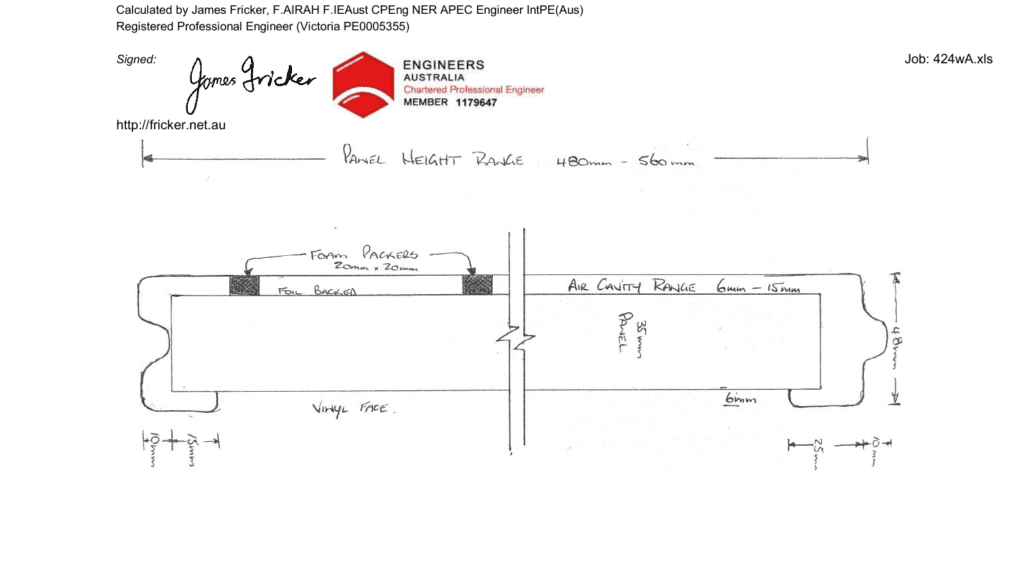
Construction diagram and signature from the ThermaDoor thermal performance engineering report, calculated to AS/NZS 4859.2:2018 by James M Fricker, Chartered Professional Engineer, Engineers Australia Member 1179647.
ThermaDoor’s R-value claims are supported by tested documentation for the complete installed garage door assembly, not insulation material alone.

Estimate the Return on Investment of ThermaDoor
Garage Door Insulation

Use this calculator to estimate the indicative return on investment of ThermaDoor garage door insulation based on your location, garage door size, household situation and electricity rate.
 
This calculator is based on ThermaDoor-specific product information and verified complete installed garage door assembly performance. It should not be used to estimate or assume the return on investment of other products being installed as garage door insulation, particularly where those products rely on material-only R-values, unsupported installed R-value claims or no verified complete assembly data.

Step 1: Where are you located?

Your climate affects how much thermal load your garage door creates and how much insulation can help.

Step 2: What size is your garage door?

Larger doors have more surface area, so insulation has a greater impact on thermal load.

Step 3: Tell us about your home

These factors determine how much the garage door's thermal performance affects your living spaces and energy use.

Is the garage attached to your house?
Do you use the garage as a workshop, gym, or living space?
Do you run air conditioning or heating in rooms adjoining the garage?
$ /kWh
ℹ️ Australian residential rates currently range from around $0.26 to $0.44/kWh depending on your state and retailer. Your rate is shown on your electricity bill.

Your results are ready

Based on your inputs

Without ThermaDoor

R0.0

Uninsulated steel door

No thermal resistance

ThermaDoor

R1.43

Winter assembly R-value

R1.39 summer

AS/NZS 4859.1 & 4859.2:2018

What ThermaDoor does for your door

Up to 90% reduction in radiant heat transfer through the garage door surface
Garage door assembly improved from R0.0 to R1.43 (winter) / R1.39 (summer) — independently engineered for ThermaDoor under AS/NZS 4859.1 & 4859.2:2018. These are garage door-specific assembly values, not material or wall R-values.
Reduced thermal load on adjoining conditioned rooms
Improved garage comfort year-round — whether used for storage, workshop, or gym

Estimated annual energy saving

$250 – $450

Typical estimate · per year

Kit cost (DIY)

Typical payback

10-yr return

Calculated for ThermaDoor only — Australia's original purpose-made, independently tested garage door insulation

📍 Brisbane 🚪 Double Door $0.33/kWh

Conservative

$120 – $250

per year

Typical

$250 – $450

per year

High Usage

$450 – $700+

per year

Return on investment — based on your DIY kit price

Scenario Annual saving Payback 10-yr saving

Kit from $320 inc. GST. Freight additional — calculated at checkout.

Your inputs

Location
Door size
Garage attached to house
Garage used as workshop/gym
AC/heating in adjoining rooms
Electricity rate
Important — ThermaDoor specific: All estimates in this calculator are based exclusively on the verified assembly R-values of ThermaDoor (R1.43 winter / R1.39 summer), independently determined under AS/NZS 4859.1 & 4859.2:2018. ThermaDoor is Australia's original purpose-made garage door insulation and the only product with independently engineered, garage door-specific assembly R-values. These results cannot be assumed for any other product. Actual energy savings will vary depending on home construction, garage orientation, air leakage, heating and cooling habits, and your electricity tariff. This calculator does not constitute a guarantee of energy savings. Plan around the conservative estimate.

Your ThermaDoor Installation Options

Ready to get started?

ThermaDoor is available as both a DIY garage door insulation kit and through professional supply-and-install via our authorised distributor network.

Option 1

DIY Installation

Measure your garage door panels, order the correct ThermaDoor kit, and install the insulation yourself using our step-by-step guides. ThermaDoor DIY kits are designed for suitable sectional and tilt garage doors, with no adhesives and no permanent changes to the door.

For a general guide, indicative DIY kit pricing is shown below. 

Door Size Panels Price (from)
Single Door8 panelsFrom $320
Single Door (Large)10 panelsFrom $360
Double Door16 panelsFrom $640
Double Door (Large)20 panelsFrom $720

* Prices include GST. Freight not included — calculated at checkout based on your postcode. No obligation to buy.

Option 2

Supply & Installation

Prefer to leave it to the experts? Our trained distributor network installs ThermaDoor panels professionally across Australia. Send us a photo of your door and we will confirm availability in your area.
 
Professional installation available in most metro and regional areas. Contact us to confirm availability.

*T&C’s apply, not available in all areas. 

For Builders, Designers and Assessors

For builders, designers and energy assessors, the value of ThermaDoor garage door insulation is that it gives the garage door a clearer documentation pathway. Instead of treating the garage door as an unknown surface, a generic insulation item or an unsupported product claim, ThermaDoor provides product-specific information that can be reviewed as part of a broader Home Energy Rating, NatHERS, renovation or new-build discussion.
 
ThermaDoor’s verified complete installed garage door assembly R-values of R1.43 winter and R1.39 summer apply to the installed garage door assembly, not the insulation material alone. This distinction can be useful where the garage is attached to the home, positioned below living areas, shares walls with occupied rooms or may otherwise influence the thermal performance discussion.
 
Where ThermaDoor is intended for a project, it should be identified by name in plans, specifications and project documentation. This helps builders, designers and assessors distinguish ThermaDoor from generic products, material-only claims or products without verified installed assembly data, and ensures the correct product information is available when garage door insulation is being considered.

When ThermaDoor Garage Door Insulation Matters Most

ThermaDoor garage door insulation is most relevant where the garage is closely connected to the way the home is used every day. This commonly includes attached garages, garages below bedrooms or living areas, garages beside internal rooms, and garages that have been adapted into workshops, gyms, laundries, hobby rooms or recreation spaces.
 
In these situations, the garage door can be one of the largest moving panels connected to the home. If that door is uninsulated, heat can move more easily between the garage and the surrounding spaces, especially during hot summers, cold nights or periods of frequent garage use.
 
ThermaDoor can help reduce heat transfer through suitable sectional and tilt garage doors, supporting a more comfortable and usable garage environment. It may be particularly worth considering where the garage is not just used for car storage, but forms part of the household’s everyday living, working or storage routine.
 
Common situations include:
 
  • Attached garages
  • Garages below bedrooms or living spaces
  • Garages beside internal rooms
  • Garages used as workshops, gyms, laundries or recreation spaces
  • Homes where the garage door is a large uninsulated moving panel connected to the house
Insulated garage man cave — ThermaDoor garage door insulation Australia
Garage door insulation can be especially useful where the garage is used as an everyday living, working or recreation space.

What ThermaDoor Does Not Claim

ThermaDoor does not guarantee a better Home Energy Rating, NatHERS result or energy-efficiency outcome on its own. A home assessment depends on the whole building, including orientation, glazing, wall and ceiling insulation, ventilation, sealing, shading, climate zone and other design factors.
 
What ThermaDoor provides is a purpose-made garage door insulation system with verified installed garage door assembly performance. That gives homeowners and project professionals clearer documentation when the garage door is part of a wider energy-performance, renovation, new-build or comfort discussion.
 
This honest distinction is important. ThermaDoor should be treated as one documented component in the broader home performance conversation, not as a standalone rating solution.

Useful Links and Documentation

For homeowners, builders, designers and assessors reviewing ThermaDoor garage door insulation in a Home Energy Rating, NatHERS, renovation or new-build context, these resources provide the key product information, verified thermal performance documentation and buyer guidance.

Use these links to confirm ThermaDoor’s verified complete installed garage door assembly R-values of R1.43 winter and R1.39 summer, understand how the product differs from generic products or products not verified for use as an installed garage door assembly, and support clearer project documentation where ThermaDoor is intended to be named in plans and specifications.

Frequently Asked Questions

How does ThermaDoor garage door insulation relate to Home Energy Rating?

ThermaDoor garage door insulation may be relevant to Home Energy Rating discussions where the garage is attached to the home, positioned below living areas, or affects rooms used for everyday living. The garage door is often one of the largest moving panels in the building, and an uninsulated garage door can allow significant heat transfer through the garage opening.
 
For new builds, renovations, extensions and energy upgrade discussions, the key is to make sure ThermaDoor garage door insulation is named in the plans, specifications or project documentation. This helps builders, designers, homeowners and assessors identify the intended product and refer to ThermaDoor’s verified installed assembly R-values, rather than treating the garage door insulation as a generic product or a product not verified for use as an installed garage door assembly.
No. ThermaDoor does not guarantee a Home Energy Rating, NatHERS star-rating improvement or assessment outcome. Home Energy Rating and NatHERS assessments consider the home as a whole, including construction, orientation, glazing, insulation, ventilation, climate, energy use and other building features.
 
ThermaDoor’s role is to provide a purpose-built garage door insulation system with verified installed assembly R-values and supporting documentation. The strongest approach is to have ThermaDoor specified by name where it is intended for the garage door, so the correct product and performance data are visible from the start.
ThermaDoor has independently verified installed garage door assembly R-values of R1.43 winter and R1.39 summer. These figures are calculated on the complete installed garage door assembly, not just the insulation material by itself.
 
This distinction matters because garage doors are moving assemblies with metal skins, joins, frames and thermal bridging. For garage door insulation, complete installed assembly performance is the required basis under Australian standards when thermal performance is assessed for the installed door. Naming ThermaDoor garage door insulation in the project documentation helps ensure those tested assembly figures are the figures being considered.
Complete installed assembly R-values are important because a garage door is not the same as a wall, ceiling or roof space. A sectional or tilt garage door includes metal surfaces, moving sections, hinges, gaps, framing and other components that affect heat transfer.
 
Material-only R-value claims can make an insulation product appear stronger than it performs once installed on a garage door. ThermaDoor’s R-values are based on the complete installed door assembly, which is why the product should be identified as ThermaDoor in plans, specifications and documentation rather than described only as “garage door insulation”. This avoids confusion with generic products or products not verified for use as installed garage door assemblies.
Yes. ThermaDoor can help reduce heat transfer through suitable sectional and tilt garage doors, which may support better comfort in homes where the garage affects adjoining rooms, rooms above the garage, internal access areas or converted garage spaces.
 
The level of benefit will vary depending on the home, door type, climate, orientation, air leakage and how the garage connects to the rest of the house. For this reason, homeowners should use ThermaDoor’s thermal performance documentation, ROI Calculator and Buyer’s Checklist when discussing the product with builders, designers or assessors. Where ThermaDoor is intended, it should be listed by name so the discussion stays tied to the tested product.
Yes. The ThermaDoor ROI Calculator is designed to help homeowners estimate the potential return on investment of ThermaDoor garage door insulation using indicative costs and performance assumptions based on ThermaDoor’s tested installed assembly data.
 
It should not be used to justify generic products or products not verified for use as installed garage door assemblies. The calculator provides a practical starting point for considering cost, comfort, room usability and long-term home performance before requesting a quote, speaking with a builder, or deciding whether ThermaDoor should be included in project documentation.
Yes. Where ThermaDoor garage door insulation is being included in a new build, renovation, extension or Home Energy Rating discussion, it should be noted by name in the plans, specifications or project documentation wherever possible.
 
This helps builders, designers, homeowners and assessors clearly identify that the intended product is ThermaDoor garage door insulation, not a generic product or a product not verified for use as an installed garage door assembly. Naming ThermaDoor also keeps the discussion tied to the correct installed assembly data: R1.43 winter and R1.39 summer, calculated on the complete installed garage door assembly.
ThermaDoor’s key documentation is available through the product page, thermal performance report, Buyer’s Checklist and Trade & Industry Hub. These resources help homeowners, builders and designers understand what has been tested, how the R-values have been calculated, and why ThermaDoor should be specified by name when it is intended for a project.
 
Homeowners should use the Buyer’s Checklist before comparing garage door insulation products, especially where Home Energy Rating, NatHERS, comfort or long-term performance is part of the decision. The checklist helps identify whether a product is purpose-made for garage doors, whether it has complete installed assembly R-values, and whether the claims are backed by appropriate evidence.

ThermaDoor Installation

Let our experts handle installation for you
Or Ask Us A Question

Call, text, or send an enquiry below to see if we have an installer in your area.

Make an Enquiry