Garage door insulation is harder to compare than it looks. This free checklist gives you a clear, standards-based framework so you can make a confident, informed decision — regardless of which product you choose.
Engineered composite insulation. Independently verified R-values. Built specifically for the mechanics of your garage door.
BEFORE YOU BUY
Most garage door insulation is marketed using terminology borrowed from walls and ceilings — R-values from raw materials, fixing methods designed for static walls, and compliance claims with no documentation behind them. This free checklist gives you six clear questions to ask before you buy, so you can compare any product — including ours — on the factors that actually matter.
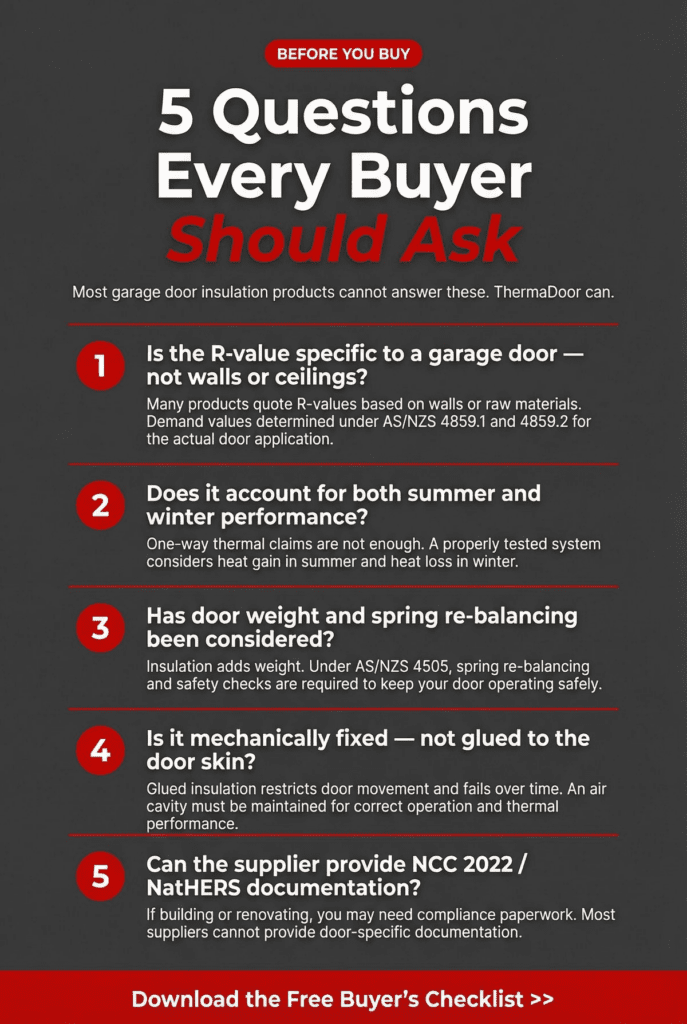
Confirms whether quoted R-values apply to a real installed garage door assembly — not raw material figures borrowed from wall or ceiling insulation. Dual-season performance (summer and winter) should both be documented.
Checks whether the product is a purpose-built composite system — combining bulk insulation, a radiant barrier, and an engineered air cavity — or a single repurposed material that addresses only one mode of heat transfer.
Covers how the insulation is fixed to the door, whether the air cavity is maintained after installation, whether added weight has been accounted for, and how safe door operation is preserved — including spring re-balancing under AS/NZS 4505, the Australian Standard for garage door safety.
Checks whether the product includes a built-in vapour barrier to manage condensation rather than trap it against the steel, and whether materials are suited to the long-term demands of an Australian garage environment.
Provides prompts for homeowners who may need supporting documentation for a Home Energy Rating — whether for a new build, renovation, or existing home upgrade. What all programs have in common is the need for verified assembly data, not marketing claims — and whether the supplier can actually provide it.
Asks the most fundamental question first — whether the product has a published R-value at all. A supplier who does not provide one removes the consumer's right to compare products on a standardised basis.
Est. 2012
Australia's Original System
Verified R-Values
R1.43 Winter / R1.39 Summer

Australian Made
Licence 7177
Lightweight
About 7kg - Double Door
Composite Technology
Purpose Built for Garage Doors
15 Year Warranty
Complete ThermaDoor Panel System
If a supplier or product cannot clearly answer these points, keep looking.
Garage door insulation in Australia cannot be compared in the same way as wall or ceiling insulation because a garage door is a moving system. It opens, closes, flexes slightly, and relies on springs and hardware to operate safely. Insulation products designed for fixed building elements may not perform the same way when applied to a garage door. Comparing garage door insulation requires considering door movement, added weight, fixing methods, and ongoing operation — not just material thickness or advertised R-values.
Garage door insulation R-values are often quoted in different ways. Some products list material R-values, which describe the insulation material on its own rather than how it performs once installed on a garage door. Other products do not quote an R-value at all, making it impossible for Australian homeowners to understand or compare expected thermal performance. ThermaDoor’s R-values are independently tested under AS/NZS 4859.1 and 4859.2:2018 for the complete installed door assembly — not just the insulation panel on its own. A supplier who does not publish an R-value at all removes the consumer’s right to compare products on a standardised basis.
Yes, adding garage door insulation increases the overall weight of the door, which can change door balance and spring loading. Under AS/NZS 4505 — the Australian Standard for garage door safety — spring re-balancing and safety checks are required after any modification that changes door weight. ThermaDoor panels are designed with door weight in mind, and installation instructions include guidance on spring adjustment.
The air gap is the functional component that allows the foil radiant barrier to work — without it, the foil cannot reflect radiant heat and simply conducts it instead. This is why composite garage door insulation systems that maintain an engineered air cavity consistently outperform single-material products glued flat to the door skin. An air gap also allows the garage door to continue operating as it was designed to — opening, closing, and flexing naturally with temperature changes. When insulation is glued directly to the door skin, that natural movement can be restricted, placing unnecessary stress on the door over time. ThermaDoor panels are mechanically fixed, not glued, preserving both the air cavity and door movement.
The garage door insulation buyer’s checklist is designed for Australian homeowners who want a clearer way to compare garage door insulation options. It can be used when researching products online, comparing quotes, planning a DIY installation, or discussing options with an installer or energy assessor. The checklist helps bring clarity to an area where information and terminology are often inconsistent — particularly around R-values, fixing methods, and compliance documentation.
Composite garage door insulation is a purpose-built system that combines bulk insulation, a radiant barrier, and an engineered air cavity to address all three modes of heat transfer — conduction, radiation, and convection — in both summer and winter. Unlike single-material products repurposed from walls, ceilings, or pipes, a true composite system is engineered specifically for the daily movement and thermal demands of an Australian garage door. ThermaDoor is the only composite garage door insulation system in Australia with independently verified dual-season assembly R-values.
Use it to compare garage door insulation options clearly before you spend a cent. One page. Plain English. Built for Australian garage doors.
Call or send an enquiry below to see if we have an installer in your area.
"*" indicates required fields
