Purpose-Made Garage Door Insulation in Australia

Home / Australian Standards & Compliance / Purpose-Made Garage Door Insulation in Australia
When ThermaDoor launched in 2012, we coined the phrase purpose-made garage door insulation.
 
We meant it literally.
 
The product had been engineered from the ground up — lightweight for garage doors, composite construction, engineered air cavity, independently verified assembly R-values, the lot.
 
It was purpose-made because nothing else existed that actually was.
 
Thirteen years later, we are delighted to report that purpose-made has become the most popular phrase in the Australian garage door insulation market.
 
Pipe lagging rubber … purpose-made. Commercial wall insulation … purpose-made. Plain graphite polystyrene board glued to a steel door … purpose-made.
 
We take it as a compliment. Genuinely. When others start borrowing your language, it means the market has recognised that what you stand for matters. Imitation is the sincerest form of flattery, and all that.
 
The problem — and there is a problem — is that when the language travels without the engineering behind it, the people who lose out are the homeowners trying to make a sensible decision. “Purpose-made” stops meaning anything. It becomes the insulation equivalent of “artisan” on a supermarket bread loaf.
 
So, let’s talk about what the phrase actually requires. And what, it turns out, a surprising number of products have decided it does not.

What Purpose-Made Actually Means for a Garage Door

A garage door is not a wall. It is not a roof. It is not a plumbing pipe.
 
It is a thin steel structure that flexes and vibrates every day of its working life, reaches surface temperatures above 80°C in direct afternoon sun, cycles through extreme heat and cold, and is spring-balanced to a precise weight. Any product that is genuinely purpose-made for this environment has to address all of those demands — not just the ones that are convenient to mention.
 
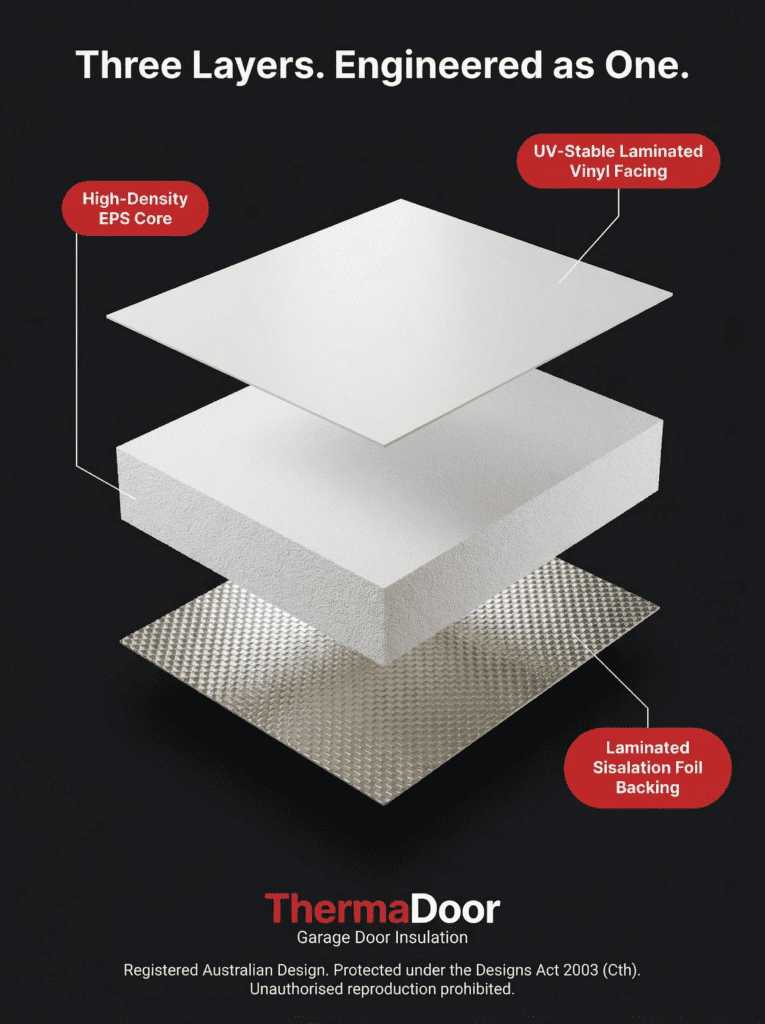
ThermaDoor is a three-layer composite system: a construction-grade EPS core that resists conducted heat, a laminated sisalation foil backing that reflects radiant heat across an engineered air cavity and acts as a Class 2 vapour barrier, and a UV-stable vinyl face that protects the whole assembly from Australia’s climate for the life of the door. Every panel is factory-laminated under controlled pressure and temperature. The air cavity is maintained by purpose-made foam spacers. The fixing is friction — no adhesives that degrade or restrict the door’s natural movement.
 
Most importantly, the system has been independently verified by a registered thermal engineer. The Total Assembly R-values — R1.43 in winter and R1.39 in summer — are calculated in full accordance with AS/NZS 4859.1 and 4859.2:2018, the standards referenced by the National Construction Code. That report is published on this website. Anyone can read it.
 
That is what “purpose-made” means. It is not a description of the cutting process. It is not a description of the delivery method. It is a description of the engineering.
Exploded diagram of ThermaDoor garage door insulation panel showing UV-Stable Laminated Vinyl Facing, High-Density EPS Core, and Laminated Sisalation Foil Backing

What Purpose-Made Is Currently Being Used to Describe

Pipe Lagging Rubber

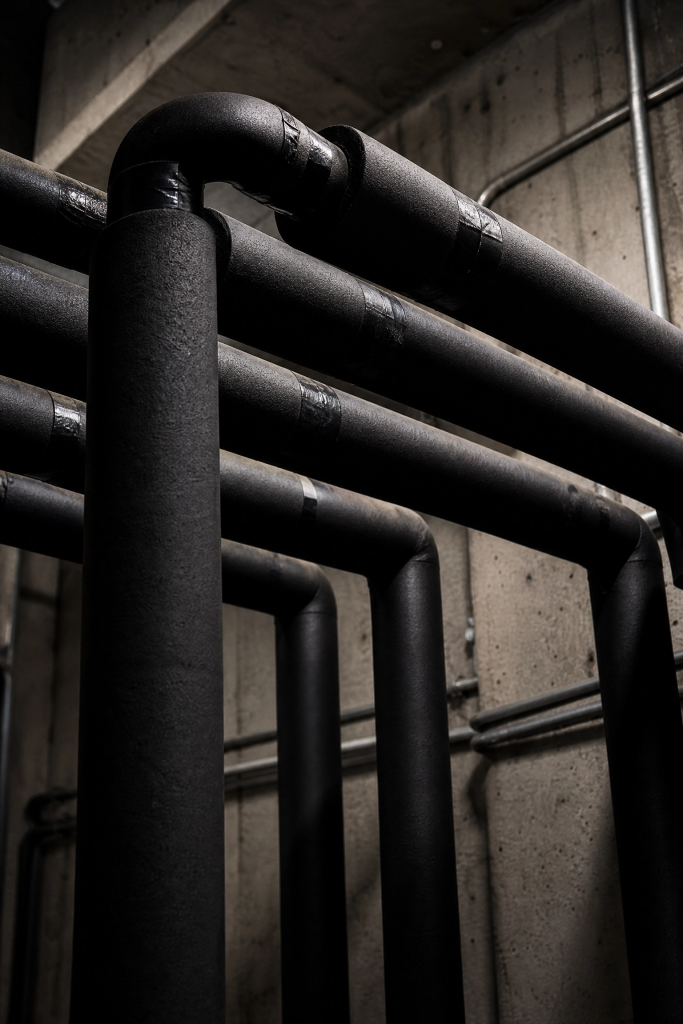
One product uses closed-cell elastomeric rubber. The product’s own FAQ is admirably candid about its origins, stating that it “utilises closed-cell insulation technology commonly used in pipe lagging applications.” It is sold as a peel-and-stick system — cut to size, peel the backing, stick it to the door. Simple.

The product claims a “verified R-1.31 thermal rating across the door.No independent engineering report to AS/NZS 4859.2:2018 is published to support this figure. The product is adhered directly flat against the steel door skin with no maintained air gap.
 
Then there is the weight. At a density of 40–50 kg/m³, a double door kit adds 13–16 kg to the door. A standard residential steel garage door weighs somewhere between 60 and 120 kg depending on its size and construction. That means this product can add up to 25% of the weight of a lighter door in one installation. The seller’s response to this is to suggest buyers hang a 15 kg weight on the door and see if the opener still runs. That is a motor load test. It tells you nothing about whether the torsion or extension springs — which are calibrated to the door’s specific weight and are responsible for safe manual operation if the motor ever fails — are still correctly balanced. AS/NZS 4505 requires that a garage door operates safely and reliably after any modification. A spring that is out of balance does not just wear faster; it can fail suddenly, causing the door to drop without warning. Claiming that spring adjustment is required in only 1% of cases, for a product that can add up to a quarter of the door’s original weight, is a position that would be difficult to defend in front of a garage door engineer.
 
The product’s Our Story page describes it as “a product designed not just for thermal performance but simple for everyday people to install themselves.” That is a fair description of a peel-and-stick pipe lagging product. Whether it is a fair description of purpose-made garage door insulation is a different question.
 
For a full look at why rubber peel-and-stick products fall short in a garage door application — including the air gap problem, the weight issue, and the unverified R-value — read our dedicated article: Rubber Peel-and-Stick Garage Door Insulation: What You Need to Know.
Closed-cell elastomeric rubber pipe lagging insulation on industrial pipes — the same material sold as garage door insulation in Australia

Commercial Wall Insulation

A couple of companies selling garage door insulation use PIR (Polyisocyanurate) foam. PIR is a rigid, brittle board developed in the 1960s for commercial roofing systems and static wall cavities. It is genuinely excellent in those applications. It is designed to be mechanically fastened in place and never move again.
 
The manufacturer’s own website describes their garage door product as “a dedicated high-performance insulation specifically for panel lift garage doors“. The product is cut from standard commercial PIR board and inserted into the door’s panel cavities.
 
Here is the thing about PIR and movement: peer-reviewed engineering studies confirm it is brittle under tension. A garage door flexes every time it operates. The manufacturer’s own technical datasheet also warns that special precautions must be taken in conditions of high humidity and water vapour condensation — which is a fairly precise description of what a steel garage door experiences every single day in the Australian climate. No independent AS/NZS 4859.2:2018 assembly engineering report is publicly available for this product.
 
Dedicated. Specifically. Purpose-made. The words are doing a lot of heavy lifting for a commercial roofing board.
 
We have covered the full case against PIR in a garage door application — the brittleness under tension, the moisture risk, the weight question, and the R-value problem — in our dedicated article: .

Plain Graphite Polystyrene Board

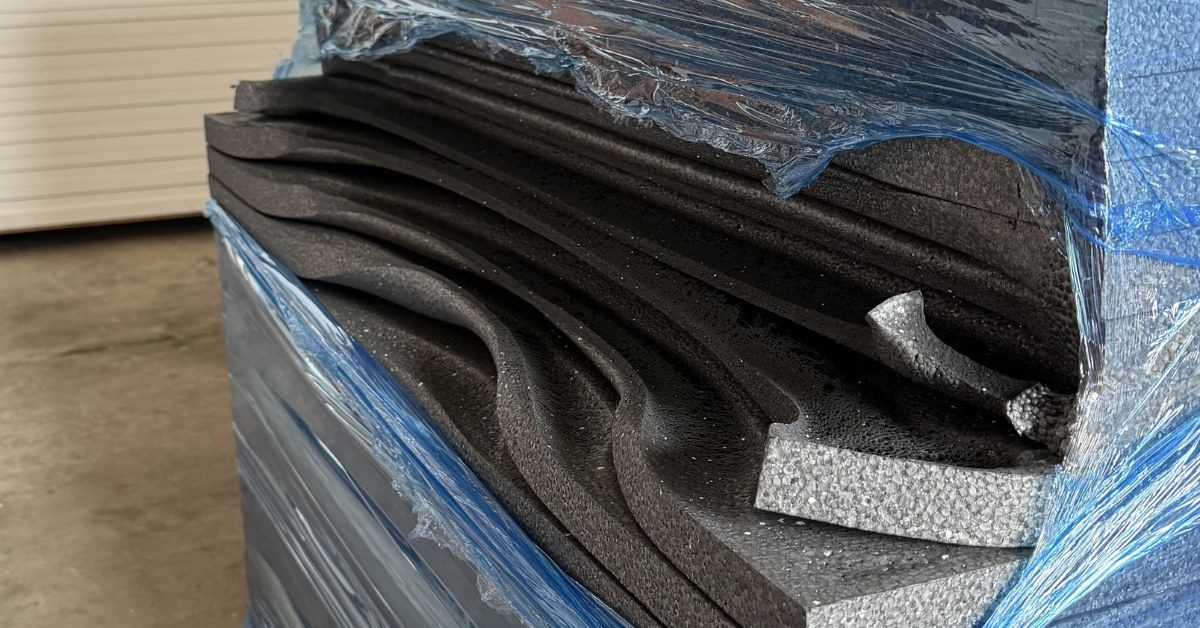
Plain graphite polystyrene board cut from standard building sheets — sold as purpose-made garage door insulation in Australia

Another product touted as garage door insulation is plain graphite polystyrene (GPS ) board — a standard construction material most commonly found in rendered exterior walls. On social media, it is advertised with the words: "Our purpose-made insulation is designed to help... reduce radiant heat transfer."

We will try to say this as gently as possible: graphite polystyrene is a bulk insulation material. It has no foil facing. It has no reflective surface. It works by slowing conducted heat as it passes through the foam — the same fundamental mechanism as a wall batt or a ceiling batt. Bulk insulation and reflective insulation are two entirely different categories of product, operating on two entirely different principles of physics. Claiming that plain polystyrene foam reduces radiant heat transfer is a statement that would raise eyebrows in any first-year building science class.

There is also a rather inconvenient property of graphite that the marketing tends to skip over. The dark grey colour — the colour that makes the panels look premium and high-tech — is caused by the graphite particles. Those same particles are very good at one thing in particular: absorbing heat. On a steel garage door that can reach 60–80°C in an Australian summer afternoon, that is not a feature you want in a foam panel pressed against the steel.

The panels are described on the company's own website as being "professionally measured, cut and installed on-site" — meaning they are cut from standard building sheets at the customer's property on the day of installation. They are then glued directly to the door skin. No engineered air gap. No mechanical fixing. No foil. No vapour barrier. No published independent assembly R-value under AS/NZS 4859.2:2018.

Purpose-made. We have written a full technical article on the science of graphite polystyrene in garage door applications — the peer-reviewed research on heat softening, moisture absorption, and long-term performance degradation — if you would like the complete picture: Graphite Garage Door Insulation: The Honest Facts.

The Difference Between Borrowing Language and Earning It

The reason “purpose-made” resonates with consumers is that it points to something real. There is a genuine and important difference between a product engineered for a specific application and one adapted from somewhere else. Homeowners are right to care about that distinction. It affects how the product performs, how long it lasts, and whether the R-value on the label reflects what they will actually experience in their garage.
 
When the phrase is applied to a commercial wall and roofing board, a wall insulation panel cut on a driveway, or a pipe lagging product with a peel-and-stick backing, that distinction disappears. The consumer is left comparing products using a term that no longer means anything consistent.
 
The way to cut through it is straightforward: ask for the evidence. Ask what the material was originally designed for. Ask how the air gap is maintained between the insulation and the steel door skin. Ask for the independent engineering report showing the Total Assembly R-value calculated specifically for a garage door under AS/NZS 4859.2:2018 — with separate winter and summer figures, as the standard requires.
 
If a product is genuinely purpose-made for a garage door, that documentation exists and the manufacturer will publish it without hesitation. If it does not exist, the claim is marketing. Confident, enthusiastic marketing — but marketing nonetheless.
 
ThermaDoor has published its engineering report since the beginning. That is what the term was always meant to mean. We are glad the rest of the market agrees it matters. We would just love it if the claims matched the product.
 
Not sure what to ask before you buy? Our free Garage Door Insulation Buyer’s Checklist covers exactly that.
 

Frequently Asked Questions

What does "purpose-made" garage door insulation actually mean?

A genuinely purpose-made garage door insulation system is engineered specifically for the demands of a moving steel door — not adapted from another application. It addresses conducted heat, radiant heat, condensation, door weight, and mechanical movement. The clearest proof of a purpose-made product is an independently verified Total Assembly R-value calculated for a garage door under AS/NZS 4859.2:2018, supported by a published engineering report.

PIR (Polyisocyanurate) foam is a commercial roofing and wall board designed to be mechanically fastened in place and never move. Peer-reviewed engineering studies confirm it is brittle under tension — a significant concern for a door that flexes every time it operates. The manufacturer’s own technical datasheet warns of risks in high-humidity and condensation conditions, which are standard conditions for a steel garage door. No PIR garage door product we are aware of currently available in Australia publishes an independent AS/NZS 4859.2:2018 assembly engineering report.

No. Graphite polystyrene (GPS) is a bulk insulation material. It works by slowing conducted heat as it passes through the foam — the same mechanism as a wall batt or ceiling batt. It has no foil facing and no reflective surface. Claims that plain graphite polystyrene reduces radiant heat transfer are not supported by the physics of how the material works. A reflective insulation product requires a low-emissivity foil surface and an adjacent air space to function.

Rubber peel-and-stick products use closed-cell elastomeric rubber — a material designed for insulating plumbing pipes. When applied to a garage door, it is glued flat against the steel skin with no maintained air gap. Based on the manufacturer’s published density range of 40–50 kg/m³, a double door kit can add 13–16 kg — up to 25% of the weight of a lighter residential door. AS/NZS 4505 requires that a garage door operates safely and reliably after any modification. Adding significant weight without professional spring rebalancing creates a safety risk.

The relevant measure is a Total Assembly R-value calculated under AS/NZS 4859.2:2018 — not a material R-value measured in isolation. The assembly R-value accounts for thermal bridging through the steel door frame, which can reduce real-world performance significantly compared to the foam’s standalone figure. A dual-season report (separate winter and summer values) is required under the current standard. To our knowledge, as of the date of publication, ThermaDoor is the only garage door insulation product in Australia with a published independent engineering report providing dual-season Total Assembly R-values: R1.43 (winter) and R1.39 (summer).

Ask three questions: What was the base material originally designed for? How is the air gap between the insulation and the steel door skin maintained? Can the manufacturer provide an independent engineering report showing dual-season Total Assembly R-values calculated for a garage door under AS/NZS 4859.2:2018? A product that cannot answer all three with published documentation is a repurposed material, not a purpose-built system.

Yes. Garage door springs are calibrated to the door’s specific weight. Any addition of weight — regardless of how light the insulation claims to be — changes the load the spring must manage. A spring that is out of balance wears faster and can fail suddenly, causing the door to drop without warning. AS/NZS 4505 requires safe and reliable door operation after any modification. Professional spring rebalancing should always be carried out after insulation is installed on any garage door.

Picture of Peter Hinton
Peter Hinton

Peter is a licensed builder with over 45 years of experience in the construction industry. In 2012, his expertise in energy efficient construction inspired the invention of ThermaDoor Premium garage door insulation - the original purpose made garage door insulation in Australia.

ThermaDoor is the manufacturer of the products discussed in this article and has a commercial interest in their sale. While every effort has been made to ensure the accuracy of the information presented, readers are encouraged to conduct their own research and consult qualified professionals before making purchasing decisions. All R-values cited are independently verified assembly R-values under AS/NZS 4859.1/.2:2018.

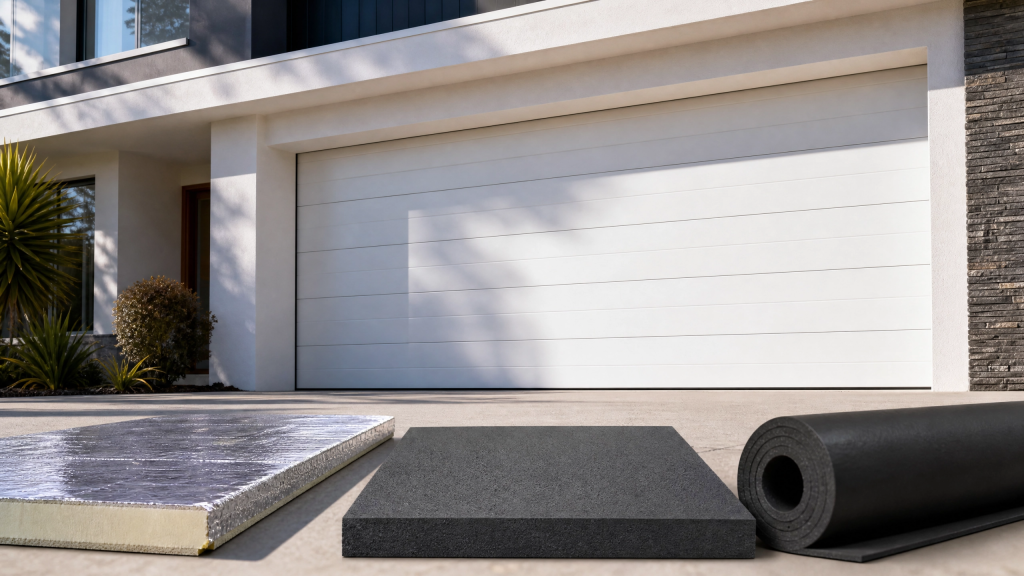
Three repurposed insulation materials — PIR roofing board, graphite polystyrene, and rubber pipe lagging — laid on a driveway in front of a modern Australian garage door

ThermaDoor Installation

Let our experts handle installation for you
Or Ask Us A Question

Call, text, or send an enquiry below to see if we have an installer in your area.

Make an Enquiry