Not All Garage Door Insulation Is Equal — Here Is What Composite Technology Does That Others Cannot

Home / Australian Standards & Compliance / Not All Garage Door Insulation Is Equal — Here Is What Composite Technology Does That Others Cannot
When it comes to insulating a garage door, the market is flooded with confusing claims, social media theatrics, inflated numbers, and repurposed products. From foam panels glued directly to the metal, to foil sheets stuck flat against the door, homeowners are often left wondering what actually works — and whether the money they spend will make any real difference to their comfort in summer heat or winter cold.
 
The reality is that a garage door is a dynamic, moving structure exposed to extreme temperature swings in both directions. In summer, it absorbs solar heat and drives it into the home. In winter, it allows warmth to escape and cold to seep in from the garage. Insulating it effectively requires more than sticking a piece of generic building foam to the back of it. It requires purpose-built composite technology.
 
But what exactly does that mean — and why is it the only way to achieve genuine, verifiable thermal performance on a garage door? Let’s break down the science of heat transfer, the Australian standards that govern insulation, and why every component of your insulation system matters.

Understanding Heat Transfer in Your Garage

To understand why composite technology is necessary, we first need to understand how heat moves into and out of your garage. Heat transfer occurs in three ways:
 
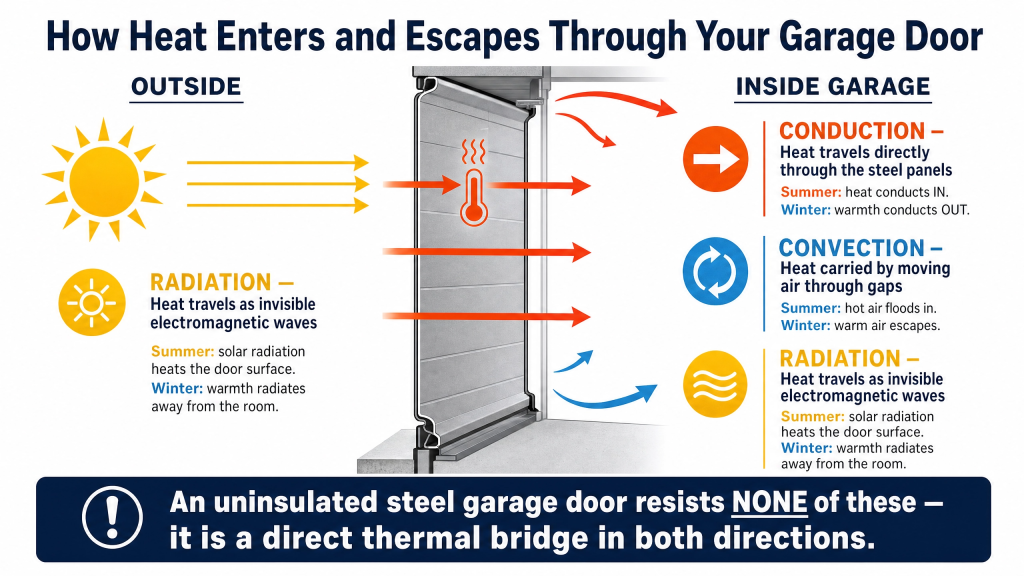
Conduction is heat travelling directly through solid materials. In summer, the sun heats the metal panels of your garage door and conducts that heat straight into the garage. In winter, warmth from inside the home conducts out through the same cold metal surface.
 
Convection is heat carried by the movement of air. Warm air escapes through gaps in winter; hot air floods in during summer.
 
Radiation is heat travelling as electromagnetic waves across an empty space. The sun radiates heat onto your door in summer, and a cold garage door radiates heat away from the room it adjoins in winter.
 
An uninsulated metal garage door offers virtually zero resistance to any of these forces. It acts as a massive thermal bridge, conducting the outside temperature directly into your home in both seasons. To stop this, an insulation system must address conductive heat using bulk insulation, and radiant heat using reflective insulation — in both directions, across both seasons.
Diagram showing the three modes of heat transfer — conduction, convection, and radiation — through an uninsulated steel garage door in summer and winter
An uninsulated steel garage door resists none of these heat transfer forces — it acts as a direct thermal bridge in both directions, summer and winter.

What Is Composite Technology?

Composite technology refers to an insulation system that combines multiple, distinct materials designed to work together to address all forms of heat transfer simultaneously — in both summer and winter.
 
Unlike generic products — such as graphite polystyrene blocks cut from wall panels, or foil-faced foam boards meant for ceilings — a true composite system for a garage door is engineered specifically for that environment and its unique demands.
 
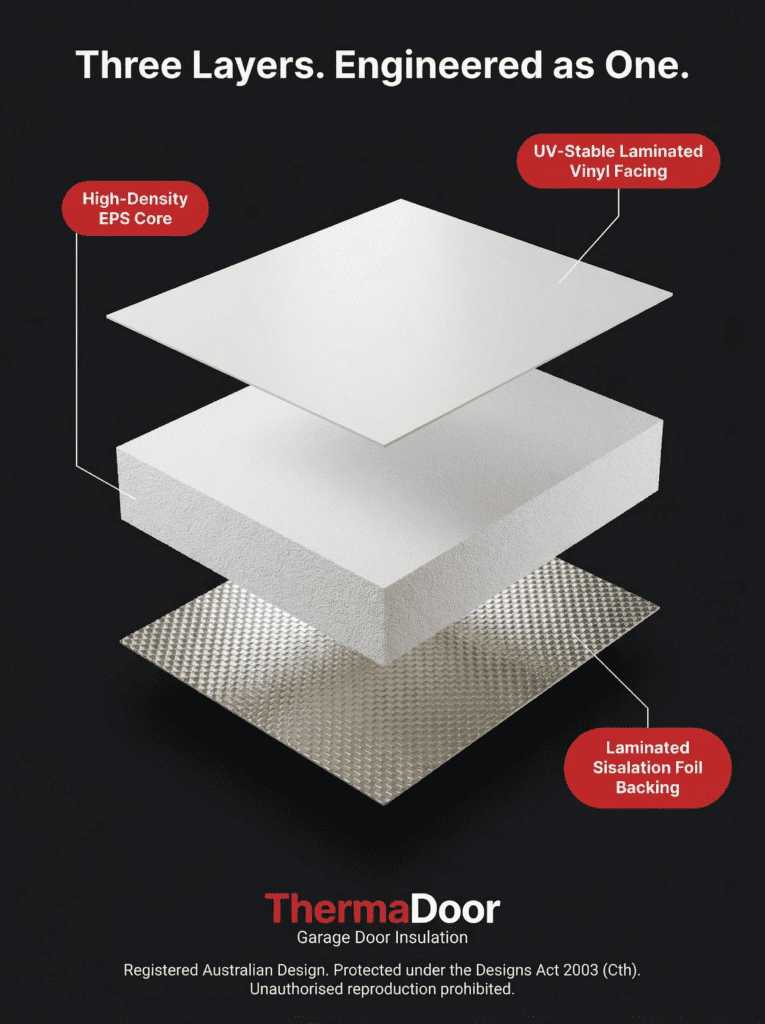
ThermaDoor is the original and only purpose-built composite technology for garage doors in Australia. It consists of four integral components:
 
1. An EPS (Expanded Polystyrene) Core. This provides the bulk insulation. EPS is a highly effective, lightweight material that resists conductive heat transfer. It slows down heat trying to pass through the door in summer, and prevents warmth from escaping in winter.
 
2. A UV-Stable Vinyl Facing. A tough, impact-resistant, and easy-to-clean interior surface that protects the core and provides a clean, finished look.
 
3. A Factory-Laminated Sisalation Foil Backing. This is the reflective insulation component. Sisalation foil is the same heavy-duty material used to wrap Australian homes for thermal protection. In summer, it acts as a radiant barrier — reflecting incoming radiant heat away from the garage before it reaches the foam core. In winter, its role is different but equally valuable: aluminium foil has an emissivity of approximately 0.03–0.05, compared to around 0.90 for most standard building materials. This extremely low emissivity means the foil surface emits very little radiant energy outward toward the cold door, reducing heat loss through radiation. The primary winter performer is the EPS core, which resists conductive heat loss in both directions — but the foil’s low emissivity provides a meaningful secondary benefit. The foil also serves as a Class 2 vapour barrier to manage condensation, which is a particular concern in cooler months.
 
4. An Engineered Air Cavity. Created by the purpose-designed spacer system, this gap sits between the metal door and the foil backing. It is not empty space — it is a functional component of the assembly.
Exploded diagram of ThermaDoor garage door insulation panel showing UV-Stable Laminated Vinyl Facing, High-Density EPS Core, and Laminated Sisalation Foil Backing
The ThermaDoor composite system — vinyl face, EPS core, and Sisalation foil backing — works as a complete assembly. The engineered air cavity between the foil and the door skin is not empty space; it is the fourth component that allows the foil to function as a radiant barrier in both summer and winter.

The Crucial Role of the Air Gap

The most misunderstood aspect of garage door insulation is the radiant barrier — and this is where many generic products fail completely, in both summer and winter.
 
For any foil-based radiant barrier to work, it must face an air space. If you take a piece of reflective foil and glue it directly to a hot metal garage door, it stops being a reflector and immediately becomes a conductor. It will simply transfer the heat straight through to the foam behind it. Think of it like putting aluminium foil directly against a hot frying pan — it doesn’t stop the heat; it conducts it.
 
The same principle applies in winter. When a foil barrier is glued flat against a cold metal surface, it is in direct contact with the steel and cannot reduce radiant emission — it simply conducts heat through to the door. The air gap is what allows the foil’s low emissivity to do its job, keeping the foil surface slightly warmer and reducing the rate at which radiant energy is lost toward the cold door.
 
Many products on the market consist of foil-faced foam panels that are glued directly to the inside of the garage door. By eliminating the air gap, they render their own foil backing completely useless as a radiant barrier — in any season.
 
ThermaDoor’s composite technology relies on an engineered air cavity. The spacer system holds the panel slightly away from the door, ensuring the foil backing always faces a pocket of air. In summer, this gap is essential — without it, the foil cannot reflect radiant heat and simply becomes a conductor. In winter, the air cavity itself contributes additional thermal resistance to the assembly, and the foil’s low emissivity continues to reduce outward radiant emission. Remove the air gap and both benefits are lost.

Why 'Repurposed' Products Fall Short

The garage door insulation market is unfortunately full of products borrowed from other industries. Here is what you need to know about each of them.
 
Graphite Polystyrene (GPS) is often marketed with impressive claims about superior thermal performance. While graphite particles do improve the thermal conductivity of polystyrene foam slightly — around 20% better than plain EPS of the same thickness — GPS was designed for walls and ceilings, not garage doors. The dark grey colour that gives it better thermal properties also causes it to absorb solar heat extremely efficiently. According to peer-reviewed research published in Energies (Krause & Nowoświat, 2020), unprotected GPS panels exposed to Australian solar radiation levels can reach their softening point of approximately 80°C, causing the panels to physically deform and fail. A dark steel garage door facing the afternoon sun regularly reaches 60–80°C on its surface — and that heat conducts directly into any foam pressed against it. GPS also provides no radiant barrier and no air gap. For the full picture on graphite polystyrene and garage doors, read our detailed breakdown here.
 
PIR (Polyisocyanurate) panels are designed for commercial roofing and static wall assemblies. PIR is a rigid, brittle foam that was never intended for a structure that flexes and vibrates with every cycle. When used as garage door insulation, it is sold with R-value claims based on its performance in thick wall cavities — not in a moving steel door. Peer-reviewed engineering research confirms PIR behaves in a brittle way under tension, making it poorly suited to the daily mechanical stresses of a garage door. Its own manufacturer’s technical datasheet warns that special precautions are required in conditions of high humidity and thermal cycling — exactly the conditions every Australian garage door faces. Read the full comparison: PIR Garage Door Insulation vs ThermaDoor.
 
Rubber peel-and-stick sheets are pipe lagging — closed-cell elastomeric foam designed to insulate stationary cylindrical pipes in controlled indoor environments like HVAC and refrigeration systems. A garage door is not a pipe. Applied as a flat sheet to a profiled steel door in full Australian sun, these products cannot conform to the door’s pressed ribs and profiles, creating sealed air pockets that trap moisture against the steel and progressively fail as the trapped air expands and contracts with every hot day and cool night. They also add approximately twice the weight of purpose-built insulation, creating a real safety risk if the door’s springs and motor force limits are not recalibrated. No independently verified assembly R-value has been published for these products in a garage door application. Read our full analysis of rubber peel-and-stick garage door insulation here.
 
Foil-only kits and roller door wraps are among the most common garage door insulation products sold online, and among the most consistently disappointing. The reason is straightforward: they are glued directly to the metal door surface with no air gap, which means the foil cannot reflect radiant heat — it simply conducts it. ThermaDoor removes failed foil installations regularly across Australia, and the story is always the same: the homeowner paid for a product that made no measurable difference. For roller doors specifically, the problem is compounded — a roller door rolls up tightly into a drum, making it physically impossible to maintain the air gap that any reflective product requires to function. Foil kits sold for roller doors have no mechanism to create or maintain this gap. Read the full breakdown: Failed Reflective Foil Insulation — A Common Mistake We See Across Australia.
 
When these generic materials are cut up, glued, or stuck to a garage door, they are not functioning as a cohesive system. They are simply building materials placed in the wrong environment.

The Importance of Verified Assembly R-Values

When comparing insulation, the R-value is the standard measure of thermal resistance — how well the product resists heat flow in either direction. Comparing R-values is like comparing shoe sizes; it is the only standardised way to know what you are actually getting.
 
However, many companies quote the “material R-value” — the rating of the foam block sitting in a laboratory — rather than the “assembly R-value”, which is how the product actually performs once installed on a real metal door in real conditions. Claiming a high material R-value while ignoring how the product is installed is highly misleading, particularly when that installation eliminates the very air gap that the foil component depends on.
 
More concerning still, some companies in the garage door insulation market do not publish an R-value at all. This is not an oversight. Without a published R-value, consumers have no standardised basis for comparison. It removes your ability — and your right — to make an informed decision. If a supplier cannot or will not tell you the R-value of their product, that alone should give you pause.
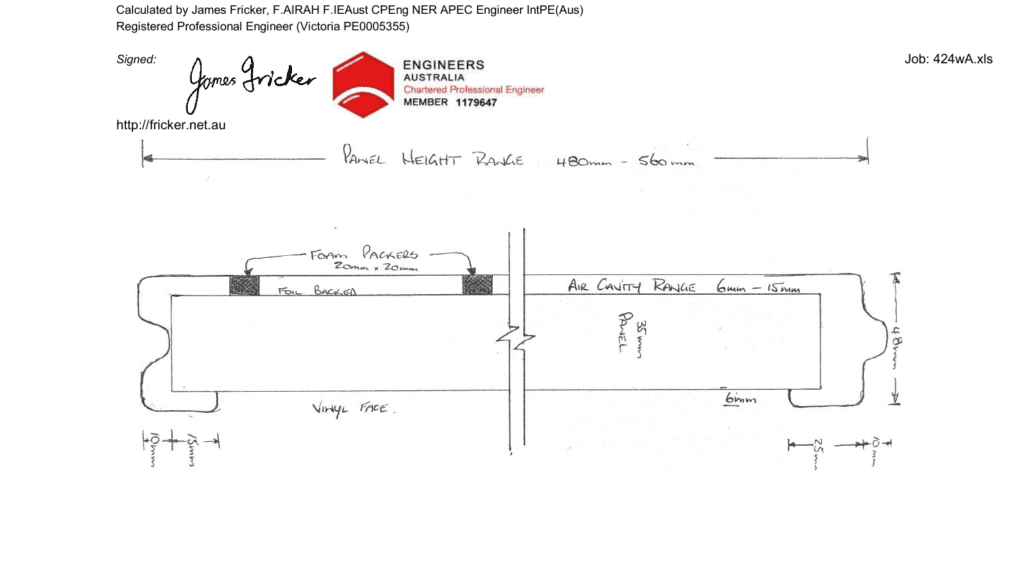
In Australia, the standard for determining the thermal resistance of building components is AS/NZS 4859.2:2018. Under this standard, the entire assembly must be calculated — not just the foam core in isolation.
 
Because ThermaDoor uses purpose-built composite technology — combining bulk insulation, a radiant barrier, and a functional air cavity — it is the only garage door insulation in Australia with independently verified, dual-season complete installed assembly R-values: R1.43 winter / R1.39 summer. The dual-season result matters because the performance of a reflective system varies between summer and winter conditions, and both need to be known. This is also the only product that allows energy assessors to confidently include the garage door in whole-of-home thermal modelling under NatHERS assessments.
ThermaDoor garage door insulation assembly diagram — independent NatHERS assessment engineering report showing R-value calculation to AS/NZS 4859.2:2018 by James M Fricker, Chartered Professional Engineer
Independent thermal performance calculations by James M Fricker, F.AIRAH F.IEAust CPEng, Registered Professional Engineer (Victoria PE0005355). Calculated to AS/NZS 4859 Parts 1 & 2:2018. Referenced by the NCC.

A Year-Round Problem Deserves a Year-Round Solution

Australians tend to think of garage door insulation as a summer product — something to stop the heat. But for the millions of Australian homes with an attached garage, the garage door is a year-round weak point in the building envelope.
 
In winter, an uninsulated or poorly insulated garage door allows cold to penetrate the garage space and, in turn, the rooms that adjoin it. Bedrooms above garages, living areas beside them, and laundries sharing a wall all suffer from the thermal performance of the garage door. A product that only addresses summer heat — or that claims to address winter cold but has no functional air gap for its foil to work — is not solving the problem.
 
ThermaDoor’s composite technology is tested and verified for both seasons. The assembly R-value of R1.43 in winter and R1.39 in summer reflects the real-world performance of the complete system in both heating and cooling conditions.

The Bottom Line

When choosing insulation for your garage door, look beyond the marketing buzzwords. Ask yourself three questions:
 
Is this product purpose-built for a garage door, or is it a repurposed wall panel, pipe lagging, or building product?
 
Does it have a foil radiant barrier, and does the installation method guarantee the required air gap for it to work in both summer and winter?
 
Has the R-value been published at all — and if so, is it a material figure or a verified complete assembly result calculated to Australian Standards?
 
True thermal performance requires a system where all components are designed to work together — in both directions, in all seasons. That is the definition of composite technology, and it is why ThermaDoor remains the original and only purpose-built solution on the Australian market.

Frequently Asked Questions About Garage Door Insulation

What is composite garage door insulation?

Composite garage door insulation is a purpose-built system that combines multiple materials — each addressing a different mode of heat transfer — into a single engineered assembly. A true composite system for a garage door includes a bulk insulation core to resist conductive heat transfer, a reflective foil radiant barrier to address radiant heat, and an engineered air cavity that allows the foil to function in both summer and winter. ThermaDoor is the original and only composite garage door insulation system in Australia, and the only product with independently verified dual-season assembly R-values of R1.43 winter and R1.39 summer under AS/NZS 4859.2:2018.

A foam panel on its own only addresses one mode of heat transfer: conduction. It does nothing to stop radiant heat, which accounts for the majority of heat transfer through a building envelope. Without a foil radiant barrier and a maintained air gap, a standalone foam panel will deliver a fraction of the thermal performance of a composite system. This is why products like graphite polystyrene blocks, PIR panels, and rubber peel-and-stick sheets — all of which lack one or more of the composite components — consistently underperform compared to ThermaDoor’s verified assembly R-values.

The best garage door insulation in Australia is a purpose-built composite system with an independently verified assembly R-value under AS/NZS 4859.2:2018. ThermaDoor is the only product that meets this standard, combining a construction-grade EPS core, UV-stable vinyl face, factory-laminated Sisalation foil backing, and an engineered air cavity — all tested as a complete assembly. No other garage door insulation product in Australia publishes dual-season verified assembly R-values for the complete installed system.

For an attached garage, an assembly R-value of at least R1.0 is a reasonable minimum, with R1.3 or higher recommended for meaningful year-round comfort. More importantly, always confirm whether the R-value quoted is a verified complete assembly result or a material figure measured in a laboratory. Material figures do not account for the thermal bridging of the steel door frame and will always overstate real-world performance. ThermaDoor’s composite system delivers a verified assembly R-value of R1.43 in winter and R1.39 in summer — the only dual-season verified figure available for any garage door insulation product in Australia.

Yes — and this is one of the key advantages of a composite system over single-material products. The EPS core resists conductive heat loss in winter, keeping warmth inside the garage and the rooms that adjoin it. The Sisalation foil’s extremely low emissivity (0.03–0.05 compared to 0.90 for most building materials) reduces outward radiant heat loss. The engineered air cavity ensures both components function as designed in both seasons. ThermaDoor’s dual-season R-values — R1.43 winter and R1.39 summer — are tested and verified for both heating and cooling conditions.

The air cavity is the fourth component of the ThermaDoor composite system, and without it the foil radiant barrier cannot function. Reflective foil only reflects radiant heat when it faces an air space — press it flat against a metal surface and it becomes a conductor, not a reflector. This is why foil-only kits glued directly to garage doors consistently fail to deliver any measurable benefit. ThermaDoor’s engineered spacer system maintains the air cavity at all times, ensuring the foil works as a radiant barrier in summer and a low-emissivity surface in winter.

Graphite polystyrene (GPS) panels have no foil radiant barrier, no air gap, and no verified assembly R-value for a garage door application. They address only conductive heat transfer and do so poorly in the Australian context — research published in Energies (Krause & Nowoświat, 2020) found GPS panels can reach their softening point of approximately 80°C under Australian solar radiation levels, causing physical deformation and failure. ThermaDoor’s composite system addresses all three modes of heat transfer with a verified assembly R-value approximately 44% higher than the estimated performance of a GPS panel on the same door.

PIR is a commercial roofing material repurposed for garage doors. It is rigid and brittle under tension — poorly suited to a structure that flexes with every cycle — and its R-value claims are based on material figures from wall cavity tests, not verified assembly results for a moving steel door. ThermaDoor’s composite system uses a flexible, impact-resistant EPS core purpose-built for garage door movement, and its assembly R-values are independently verified for the specific garage door application. Unlike PIR kits, ThermaDoor also includes a Class 2 vapour barrier to manage the condensation and moisture cycling that every Australian garage door faces.

Without a published R-value, consumers have no standardised basis to compare products — and no way to verify whether a product will actually perform. Some companies do not publish R-values because their products have not been independently tested, or because the result would not support their marketing claims. ThermaDoor publishes independently verified dual-season assembly R-values supported by a full engineering report available on the website. Every consumer has the right to compare products on a verified, standardised basis. If a supplier cannot provide an independent engineering report, their thermal performance claims cannot be confirmed.

Yes. Because ThermaDoor has independently verified assembly R-values calculated under AS/NZS 4859.2:2018 for the complete garage door assembly, it is the only garage door insulation product in Australia that can be confidently included in NatHERS whole-of-home thermal modelling. This is particularly relevant for new builds and renovations targeting the NCC 7-star energy efficiency requirement. Generic foam panels, GPS blocks, PIR kits, and foil-only products without verified assembly R-values cannot be used in this way.

ThermaDoor Installation

Let our experts handle installation for you
Or Ask Us A Question

Call, text, or send an enquiry below to see if we have an installer in your area.

Make an Enquiry