Bunnings Garage Door Insulation vs ThermaDoor: Which Is the Best Choice for Australian Homes?

Home / Materials & Product Comparisons / Bunnings Garage Door Insulation vs ThermaDoor: Which Is the Best Choice for Australian Homes?
When the Australian summer turns your garage into an oven, or a cold winter morning makes the space next to useless, it is natural to look for a quick fix. For many homeowners, that means a trip to Bunnings. The hardware giant stocks a reflective foil product marketed specifically as garage door insulation, and at $211 for a double door it looks like an easy win.
 
But look closely at the fine print — and what you find is remarkable.

What Bunnings Sells for Garage Door Insulation

Bunnings stocks the GI Building Sciences Reflecta-GDI Plus as its primary garage door insulation product. The name says it all — GDI stands for Garage Door Insulation. It is sold specifically for this purpose, listed on the Bunnings website under garage door insulation, and marketed to homeowners looking to improve the thermal performance of their door.
 
The product is a reflective foil bubble wrap: two layers of aluminium foil heat-laminated to a polyethylene air-bubble core. It is listed at $211 (at time of publication) for a roll covering approximately 12m² — enough for a standard 16-panel double garage door. The manufacturer states it reflects 97% of radiant heat, carries a 15-year guarantee, and is Australian-made.
 
And right there on the packet: R1.9.
 

Why R-Values Matter — and Why They Must Be Honest

Before we go further, it is worth explaining what an R-value actually is and why it matters so much.
 
R-value is the only standardised measure consumers have to compare insulation products. It measures how effectively a product resists heat transfer — the higher the number, the better the insulation. When you are standing in a hardware store or shopping online, the R-value is the single figure that is supposed to tell you how well a product will perform in your home.
 
That only works if the R-value is calculated for the application the product is being sold for. An R-value calculated for a wall cavity tells you how the product performs in a wall cavity. It tells you nothing about how it performs on a garage door. If a product is sold for one application but its R-value is calculated for a completely different one, consumers have no reliable basis for comparison — and no way of knowing whether the product will actually do what they are paying for.
 
This is not a technicality. It goes to the heart of whether a consumer can make an informed purchasing decision.

The Problem Nobody Tells You About

Here is where it gets interesting.
 
The R1.9 figure on the Bunnings product is not calculated for a garage door. Buried in the manufacturer’s own technical data sheet — the document most buyers never read — is a footnote that states:
 
“All calculations are for unventilated roof and wall cavities”.
 
Read that again.
 
A product called Garage Door Insulation, sold at Bunnings for garage doors, carries an R-value calculated for walls and roofs.
 
 
GIBS Reflecta-GDI data sheet footnote showing R1.9 calculated for wall and roof cavities not garage doors
Source: GI Building Sciences Reflecta-GDI V2 Technical Data Sheet (February 2025). The footnote highlighted in red states: "All calculations are for unventilated roof and wall cavities."
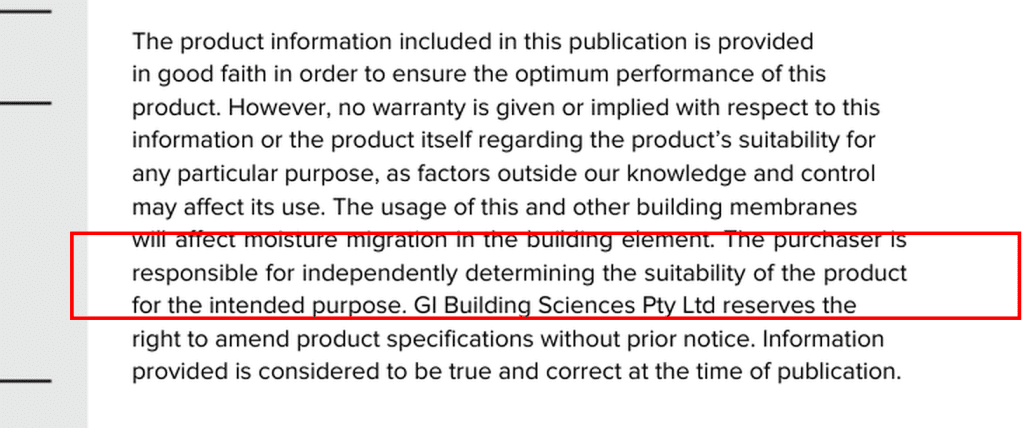
And beneath that footnote, the data sheet goes further. It states that no warranty is given or implied regarding the product’s suitability for any particular purpose — and that the purchaser is solely responsible for independently determining whether the product is suitable for their intended use.
 
Consider what those two statements mean together. The product is called Garage Door Insulation. It is sold at Bunnings specifically for garage doors. The R1.9 figure is prominently displayed on the listing. Yet the manufacturer’s own data sheet states that the R1.9 is calculated for wall and roof cavities — and that the manufacturer’s position is that the purchaser bore responsibility for determining whether the product was suitable for their specific application.
 
The R-value is on the packet. The warranty is not.
 
R-values are the only standardised tool consumers have to compare insulation products. When those figures are not calculated for the actual application in which a product is named and sold, consumers cannot make a genuinely informed purchasing decision. No publicly available independent engineering report for a garage door assembly has been identified to support the R1.9 figure in the application for which this product is named and sold.
GIBS Reflecta-GDI data sheet disclaimer stating the purchaser is responsible for independently determining product suitability
Source: GI Building Sciences Reflecta-GDI V2 Technical Data Sheet (February 2025). The highlighted sentence reads: "The purchaser is responsible for independently determining the suitability of the product for the intended purpose."

Why the R-Value Does Not Apply to Your Garage Door

Reflective foil gets its R-value from facing a large, still air gap. In a wall or roof cavity, that gap is naturally present — typically 70mm or more — and the foil reflects radiant heat across it. That is where the R1.9 comes from.
 
A garage door panel recess is nothing like a wall cavity. The recess is shallow. And the official GIBS installation guide makes the situation worse: it instructs you to press the foil silver side down, flat against the steel door panel, held in place with silicone beads. The reflective face is glued directly to the hot metal. The air gap the R1.9 depends on simply does not exist.
 
The product is called Garage Door Insulation. The R-value is calculated for a wall. The installation method eliminates the air gap the R-value requires. And the data sheet tells you it is your problem to figure that out.
 
In our experience installing and replacing garage door insulation across Australia, we regularly see foil kits that have been glued to doors — sagging, peeling, and in the assessment of our installers, delivering no discernible improvement in garage temperature.
 
If you want to understand the full picture of why reflective foil fails in this application, read our dedicated article: Failed Reflective Foil Insulation: A Common Mistake We See Across Australia.

How Each Product Is Installed

Bunnings Reflecta-GDI: Glued Flat to the Door

The official GIBS installation guide specifies that the foil is applied by running silicone beads across the silver side of the product, then pressing it silver side down, flat against the steel door panel. The foil is tucked into the edges of each panel recess and pressed down flush. The only tools required are a utility knife and a tube of Roof and Gutter Silicone.
 
There is no spacer system and no designed provision for maintaining an air gap between the foil and the door.

ThermaDoor Premium: Fitted with a Spacer System

ThermaDoor panels are mechanically fitted into the door panel recesses using a spacer system. They are not glued to the door surface. The panel sits proud of the metal, preserving an air gap between the foil backing and the steel door skin. This allows the reflective component to function as intended, and means the panels can flex with the natural movement of the door without cracking or falling away.
 
DIY kits come in 11 different sizes to suit specific door brands and sizes. 
 
Professional installation is available through an authorised distributor network across Australia.


How ThermaDoor's R-Value Is Different

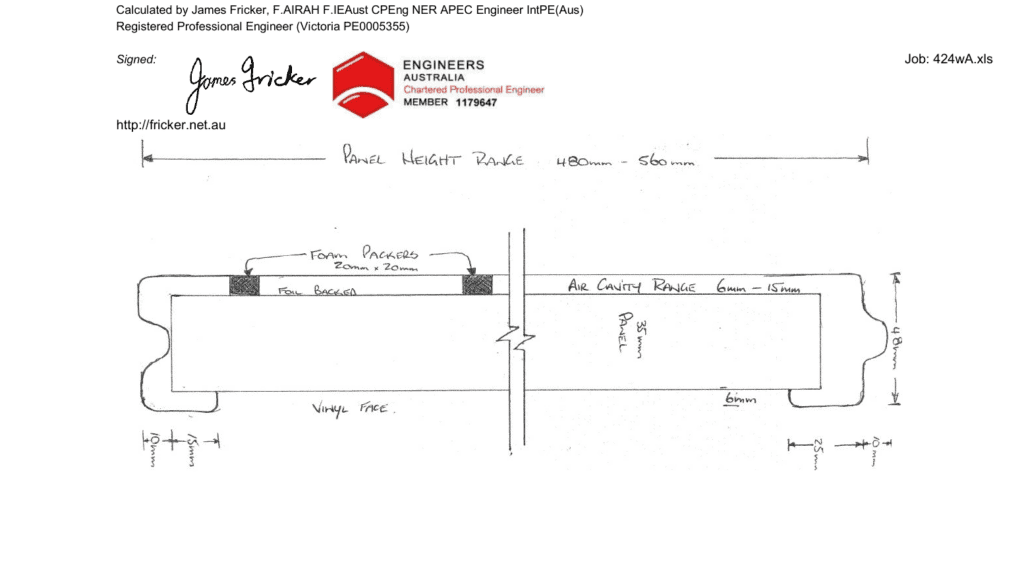
ThermaDoor’s R-values are not a number on a packet. They are independently calculated by a registered professional thermal engineer — James M Fricker, CPEng — specifically for a complete installed garage door assembly, using the Australian Standard referenced by the National Construction Code (NCC).
 
The calculation accounts for every layer of the door — the steel skins, the air gap, the foil, the 35mm EPS core, and the thermal bridging effect of the steel frame itself. Nothing is borrowed from a wall or ceiling test. The full engineering report is published on the ThermaDoor website with every assumption documented and available to read.
 
The verified, dual-season results are:
 
Season
ThermaDoor Assembly R-Value
Winter
R1.43
Summer
R1.39
These are real numbers, for a real garage door, verified by an independent engineer. Not a wall cavity. Not a roof. A garage door. This is what an honest R-value looks like — one that allows you to make a genuinely informed decision.
ThermaDoor garage door insulation assembly diagram — independent NatHERS assessment engineering report showing R-value calculation to AS/NZS 4859.2:2018 by James M Fricker, Chartered Professional Engineer
Independent thermal performance calculations by James M Fricker, F.AIRAH F.IEAust CPEng, Registered Professional Engineer (Victoria PE0005355). Calculated to AS/NZS 4859 Parts 1 & 2:2018. Referenced by the NCC.

Side-by-Side Comparison

Feature Bunnings Reflecta-GDI ThermaDoor
Product type Reflective foil (flat) 35mm EPS core with reflective foil facing
Installation method Silicone adhesive, glued flat to door panel Mechanical spacer system, air gap maintained
Declared R-value R1.9 (wall/roof cavity calculation) R1.43 (winter) / R1.39 (summer)
R-value basis Wall and roof cavity — not a garage door assembly Complete installed garage door assembly
Test standard ASTM C518 (material only) AS/NZS 4859.1 & 4859.2:2018
Independent engineering report None publicly available for garage door assembly Yes — James M Fricker CPEng (Report i424b, 2025)
Thermal bridging accounted for No Yes
Dual-season R-values No Yes

The Verdict

R-values exist so that consumers can compare products and make informed decisions. That only works when the R-value is calculated for the application the product is being sold for.
 
The Bunnings Reflecta-GDI is cheap, widely available, and has a reassuring number on the front. But the product named Garage Door Insulation carries an R-value calculated for a wall cavity — and the data sheet quietly tells you that working out whether it is suitable for your garage door is your responsibility, not theirs. That is not a basis on which any consumer can make a meaningful comparison.
 
ThermaDoor Premium is built differently, from the ground up, for garage doors. Its spacer system preserves the air gap. Its 35mm EPS core provides genuine bulk insulation. And its R-values — R1.43 in winter and R1.39 in summer — are independently verified for the complete installed door assembly by a registered professional engineer, with every assumption published and available to read.
 
A product that costs less upfront but cannot back up its R-value in the actual application is not a saving. It is a cost you may end up paying twice.

Frequently Asked Questions

What garage door insulation does Bunnings sell?

Bunnings stocks the GI Building Sciences Reflecta-GDI Plus, a reflective foil product sold specifically for garage doors. It is available in a 10mm x 0.5m x 24m roll, covering approximately 12m² — enough for a standard double garage door. The product is installed by gluing the foil directly to the door panel using silicone adhesive.

The Bunnings Reflecta-GDI is a reflective foil product that relies on a large, still air gap to achieve its headline R1.9 figure. However, the manufacturer’s own data sheet states that all R-value calculations are for unventilated roof and wall cavities — not garage door assemblies. The official installation guide instructs users to glue the foil flat against the steel door panel, which eliminates the air gap the R1.9 depends on. For homeowners seeking a meaningful improvement in garage temperature, a purpose-built product with an independently verified garage door assembly R-value is likely to deliver better results.

R1.9 is a thermal resistance value — the higher the number, the better the insulation. However, the R1.9 figure on the Bunnings Reflecta-GDI is calculated for a wall or roof cavity, not a garage door assembly. This matters because the calculation assumes a large unventilated air gap that does not exist when the foil is glued flat to a steel door panel. An R-value calculated specifically for a garage door assembly — accounting for the steel frame, the insulation insert, and the air gap — is a more reliable basis for comparison.

The best garage door insulation in Australia is one that has been independently tested and rated specifically for a garage door assembly under Australian Standards. ThermaDoor is independently assessed by a registered professional thermal engineer using AS/NZS 4859.1 and 4859.2:2018, with a verified assembly R-value of R1.43 (winter) and R1.39 (summer) — calculated for a complete installed garage door, with thermal bridging through the steel frame fully accounted for.

A material R-value measures the thermal resistance of the insulation insert on its own, in isolation. An assembly R-value measures the thermal resistance of the complete installed system — including the door skins, the air gap, the insulation, and the thermal bridging effect of the steel frame. For garage door insulation, the assembly R-value is the only figure that reflects real-world performance, because the steel frame conducts heat around the insulation insert, reducing the overall thermal resistance of the door.

Reflective foil can work in applications where it faces a large, still air gap — such as in a roof or wall cavity. In a garage door, however, the panel recesses are shallow, and most foil products are installed by gluing the foil flat against the steel surface. This eliminates the air gap that the product’s R-value depends on, meaning the foil provides little to no measurable thermal benefit in that application. For a detailed explanation of why reflective foil fails in garage doors, see our dedicated article: Failed Reflective Foil Insulation: A Common Mistake We See Across Australia.

ThermaDoor’s R-values are calculated by James M Fricker, a registered professional thermal engineer (CPEng), using AS/NZS 4859.1 and 4859.2:2018 — the Australian Standards referenced by the National Construction Code. The calculation is performed for a complete installed garage door assembly, accounting for every layer of the door including the steel skins, the reflective air gap, the 35mm EPS core, and the thermal bridging effect of the steel frame. The full engineering report is published on the ThermaDoor website and available to read.

Yes. ThermaDoor is designed for DIY installation. The spacer system mechanically holds each insulation panel in position within the door recess, maintaining the critical air gap between the foil face and the steel panel. A standard double garage door can typically be completed in under an hour. Installation instructions and a video guide are available on the ThermaDoor website.

ThermaDoor’s R-values — R1.43 (winter) and R1.39 (summer) — are assembly values calculated for a complete installed garage door, with thermal bridging through the steel frame fully accounted for. Some competing products quote higher R-values that are calculated for wall or roof cavities, or that measure only the insulation material in isolation, without accounting for the steel frame or the specific conditions of a garage door assembly. A lower R-value calculated honestly for the actual application is more meaningful than a higher figure calculated for a different structure.

Yes — particularly in climates with hot summers or cold winters. An uninsulated steel garage door absorbs and radiates heat directly into the garage, making the space uncomfortable and increasing the load on any air conditioning connected to the home. A properly installed garage door insulation system with a verified assembly R-value can significantly reduce heat transfer through the door, improving comfort and potentially reducing energy costs. The key is choosing a product whose R-value is calculated specifically for a garage door assembly, not borrowed from a wall or ceiling test.

Your ThermaDoor Installation Options

Ready to get started?

ThermaDoor is available as both a DIY garage door insulation kit and through professional supply-and-install via our authorised distributor network.

Option 1

DIY Installation

Measure your garage door panels, order the correct ThermaDoor kit, and install the insulation yourself using our step-by-step guides. ThermaDoor DIY kits are designed for suitable sectional and tilt garage doors, with no adhesives and no permanent changes to the door.

For a general guide, indicative DIY kit pricing is shown below. 

Door Size Panels Price (from)
Single Door8 panelsFrom $442.46
Single Door (Large)10 panelsFrom $543.08
Double Door16 panelsFrom $884.92
Double Door (Large)20 panelsFrom $1,086.16

Prices Include Freight & GST. A 10% discount will be applied to Brisbane and Sunshine Coast addresses at checkout due to lower local delivery costs.

Option 2

Supply & Installation

Prefer to leave it to the experts? Our trained distributor network installs ThermaDoor panels professionally across Australia. Send us a photo of your door and we will confirm availability in your area.
 
Professional installation available in most metro and regional areas. Contact us to confirm availability.

*T&C’s apply, not available in all areas. 

References

  1. Bunnings Warehouse. “GI Building Sciences 10mm 0.5 x 24m 12m² Reflecta Garage Door Insulation.” https://www.bunnings.com.au/gi-building-sciences-10mm-0-5-x-24m-12m-reflecta-garage-door-insulation_p0145153
  2. GI Building Sciences. “Reflecta-GDI Installation Guide — Document Version: December 2025.” https://gibs.com.au/wp-content/uploads/2026/03/Reflecta-GDI-Installation-Guide-1.pdf
  3. GI Building Sciences. “Reflecta-GDI™ Product Page — Specifications.” https://gibs.com.au/products/reflecta-gdi-plus/
  4. Mitre 10. “GIBS Reflecta Garage Door Insulation 10mm 0.5 x 24m 12m².” https://www.mitre10.com.au/reflecta-garage-door-plus-insulation-500mm-x-10mm-x-23m-box
  5. GI Building Sciences. “Reflecta-GDI V2 Technical Data Sheet — Issued February 2025.” https://gibs.com.au/wp-content/uploads/2025/02/Reflecta-GDI-V2-15.pdf
  6. ThermaDoor. “Failed Reflective Foil Insulation: A Common Mistake We See Across Australia.” https://thermadoor.com.au/failed-reflective-foil-insulation-a-common-mistake-we-see-across-australia/
  7. ThermaDoor. “Why ThermaDoor Premium is the #1 Garage Door Insulation in Australia.” https://thermadoor.com.au/why-thermadoor-premium-is-the-1-garage-door-insulation-in-australia/
  8. ThermaDoor. “Best Garage Door Insulation R-Value in Australia (Explained ).” https://thermadoor.com.au/garage-door-insulation-r-value-australia/
Picture of Peter Hinton
Peter Hinton

Peter is a licensed builder with over 45 years of experience in the construction industry. In 2012, his expertise in energy efficient construction inspired the invention of ThermaDoor Premium garage door insulation - the original purpose made garage door insulation in Australia.

ThermaDoor is the manufacturer of the products discussed in this article and has a commercial interest in their sale. While every effort has been made to ensure the accuracy of the information presented, readers are encouraged to conduct their own research and consult qualified professionals before making purchasing decisions. All R-values cited are independently verified assembly R-values under AS/NZS 4859.1/.2:2018.

GIBS Reflecta-GDI data sheet footnote showing R1.9 calculated for wall and roof cavities not garage doors

ThermaDoor Installation

Let our experts handle installation for you
Or Ask Us A Question

Call or send an enquiry below to see if we have an installer in your area.

Make an Enquiry