The Garage Door and Your Home Energy Rating: What You Need to Know Before You Build, Renovate or Upgrade

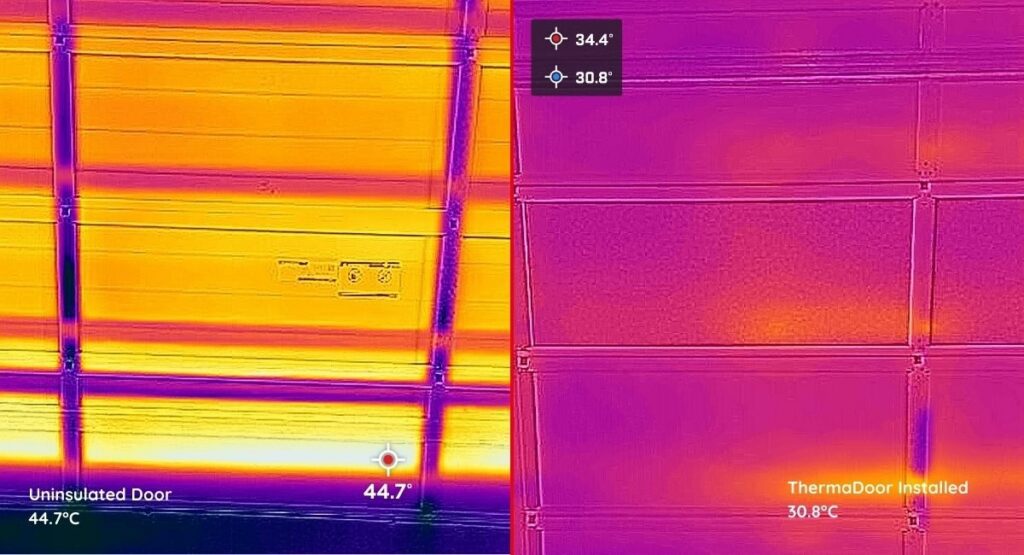
FLIR thermal image comparison showing garage door surface temperature — 41°C without insulation vs 32°C with ThermaDoor insulation
Home / Australian Standards & Compliance / The Garage Door and Your Home Energy Rating: What You Need to Know Before You Build, Renovate or Upgrade

The Garage Door and Your Home Energy Rating: What You Need to Know Before You Build, Renovate or Upgrade

When planning a new build, major renovation or upgrade for an existing home, a Home Energy Rating assessment is one of the most important steps you will take. It provides a clear picture of how comfortable your home will be and how much it will cost to run.
 
But during these assessments, one of the largest moving surfaces in your home is often completely ignored: the garage door.
 
If your garage is attached to the house, sits below occupied rooms or acts as a primary entry point, the thermal performance of the garage door matters. Yet it is routinely left out of the conversation — not because it is unimportant, but because for most garage door insulation products, there is no verified data to work with.
 
Here is what you need to know about Home Energy Ratings, why the garage door is often overlooked, and how to make sure the right information gets into the process.

How a Home Energy Rating Works

A Home Energy Rating looks at the home as a connected system, not just a collection of isolated rooms. According to the federal government’s Home Energy Rating website, an assessment “provides you with much more than a rating. It arms you with the knowledge and information you need to make smarter choices to improve your home’s energy efficiency.”
 
Assessors look at orientation, glazing, wall insulation, roof materials and ventilation to determine how much energy is required to heat and cool the home. For new builds and major renovations, this is typically done using the Nationwide House Energy Rating Scheme (NatHERS) to ensure the design meets the National Construction Code (NCC) 7-star minimum energy efficiency requirements.
 
The government has also launched a dedicated pathway for existing homes, noting that a rating “shows how a home currently performs and what improvements can be made to improve comfort and reduce energy use and costs.” Both pathways are available at homeenergyrating.gov.au.
But when the assessment reaches the garage, a problem often arises.

Who Is Involved — and When

How the garage door gets into the conversation depends on whether you are building new or upgrading an existing home.
 
For new homes and major renovations, the homeowner rarely speaks directly with the energy assessor. According to the government’s guidance on Collaboration with Assessors, it is the builder or designer who engages the accredited assessor — ideally at the early stages of the design phase, before construction begins. The assessment is based on building plans and specifications. This means the garage door needs to be specified correctly in the plans before the assessor ever sees them. If the right product is not named in the documentation, the assessor has no basis to include it.
 
For existing homes, the pathway is different. The homeowner engages an accredited assessor directly to assess the home as it currently stands. The assessor reviews the property’s construction, orientation and appliances, and identifies where improvements can be made. In this case, the homeowner can raise the garage door directly in conversation with the assessor.
 

Why the Garage Door Gets Left Out

Standard uninsulated steel sectional and tilt garage doors offer virtually no thermal resistance. They act as large heat conductors, radiating summer heat into the garage and letting winter warmth escape — particularly where the garage connects to everyday living areas.
 
When the garage door comes up in an assessment or design review, assessors and designers often struggle to factor it in. The reason is not a lack of interest. It is a lack of credible, usable data from manufacturers.
 
There are three common problems with how garage door insulation products present their performance claims — and all three leave the assessor with nothing reliable to use.
 
No R-value stated at all. Some products simply describe the material — foam, foil, polystyrene — without providing any thermal performance figure. This leaves assessors and designers with nothing to enter into their software, so the door defaults to an uninsulated value.
 
Material-only R-values. Others quote only the thermal resistance of the insulation panel itself. This is misleading in the context of a garage door because it ignores everything else heat has to travel through: the steel skins, hinges, panel joins, tracks and air gaps. These metal components conduct heat straight through the door, bypassing the insulation entirely. This process is known as thermal bridging. A material R-value does not account for it.
 
Claimed installed R-values with no supporting documentation. Some products go further and state a total or installed R-value, but provide no engineering report or independent test documentation to back it up. A number without evidence is not a verified figure — it is a marketing claim. When assessors and designers ask for the report, they are often met with silence.
 
In all three cases, the assessor is left with no credible data to use. The garage door gets left out.

The Solution: Verified Assembly R-Values

For an assessor to confidently include garage door insulation in a Home Energy Rating, they need a verified assembly R-value — one that accounts for the complete installed door, including the insulation panels, steel frame, hinges and joins, and is backed by independent test documentation.
 
ThermaDoor is Australia’s original purpose-made garage door insulation, and one of the only products on the market supported by an independent engineering report detailing verified complete installed assembly R-values.
 
Tested under Australian Standards AS/NZS 4859.1:2018 and AS/NZS 4859.2:2018, ThermaDoor provides a dual-season assembly performance of:
R1.43 (Winter) / R1.39 (Summer)
 
This gives builders, designers and energy assessors the documented evidence they need to factor the garage door into their calculations accurately — rather than defaulting it to zero.
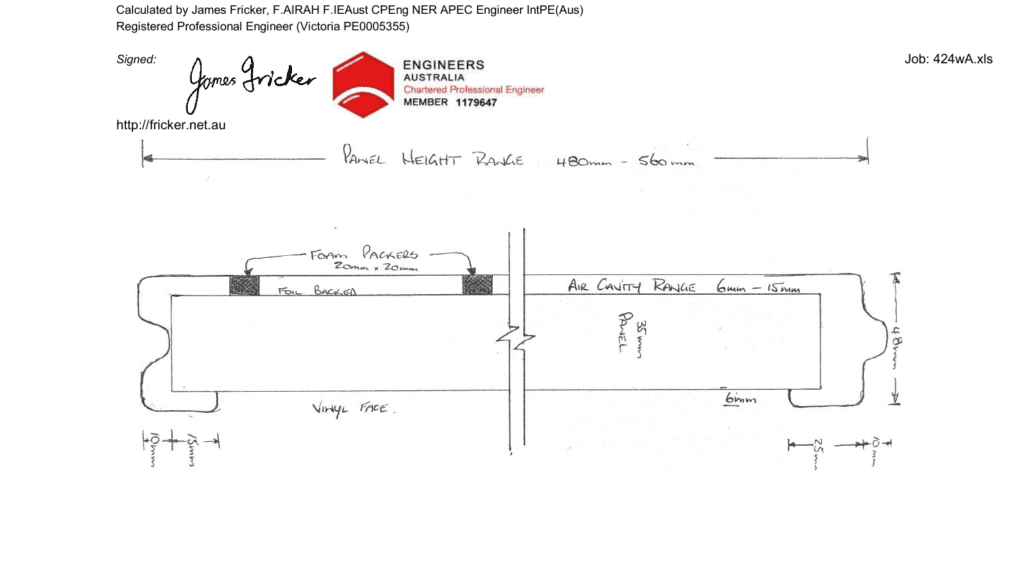
Construction diagram and signature from the ThermaDoor thermal performance engineering report, calculated to AS/NZS 4859.2:2018 by James M Fricker, Chartered Professional Engineer, Engineers Australia Member 1179647.
Independent thermal performance calculations by James M Fricker, F.AIRAH F.IEAust CPEng, Registered Professional Engineer (Victoria PE0005355). Calculated to AS/NZS 4859 Parts 1 & 2:2018. Referenced by the NCC.

How to Make Sure It Gets Included

For new builds and major renovations — talk to your builder, designer or architect
 
In most cases you will not speak with the assessor directly. The conversation starts with your builder, designer or architect. The government’s guidance is clear that working with an assessor at the early stages of the design process means “energy efficiency is built into the project from the beginning.” Your job is to make sure your builder or designer knows to specify ThermaDoor by name in the plans and documentation before the assessor sees them.
 
“We want ThermaDoor garage door insulation included in the plans. They have verified assembly R-values backed by an independent engineering report — can you make sure it’s specified by name?”
 
For existing homes — raise it directly with your assessor
 
If you are having your existing home assessed, you can raise the garage door in your initial conversation with the assessor. Point out how the garage connects to the rest of the house and provide the ThermaDoor engineering report so the assessor has the data they need.
 
“Our garage shares a wall with the living room. I’d like to insulate the door with ThermaDoor — they have a verified assembly R-value of R1.43. Can we factor this into the assessment?”
 
Your builder, designer or assessor can download the full James Fricker thermal performance report and NCC compliance data from the ThermaDoor Trade & Industry Hub.

Built for the Job

When you specify ThermaDoor, you are choosing a product engineered specifically for sectional and tilt garage doors — not a material borrowed from another application and cut to fit.
 
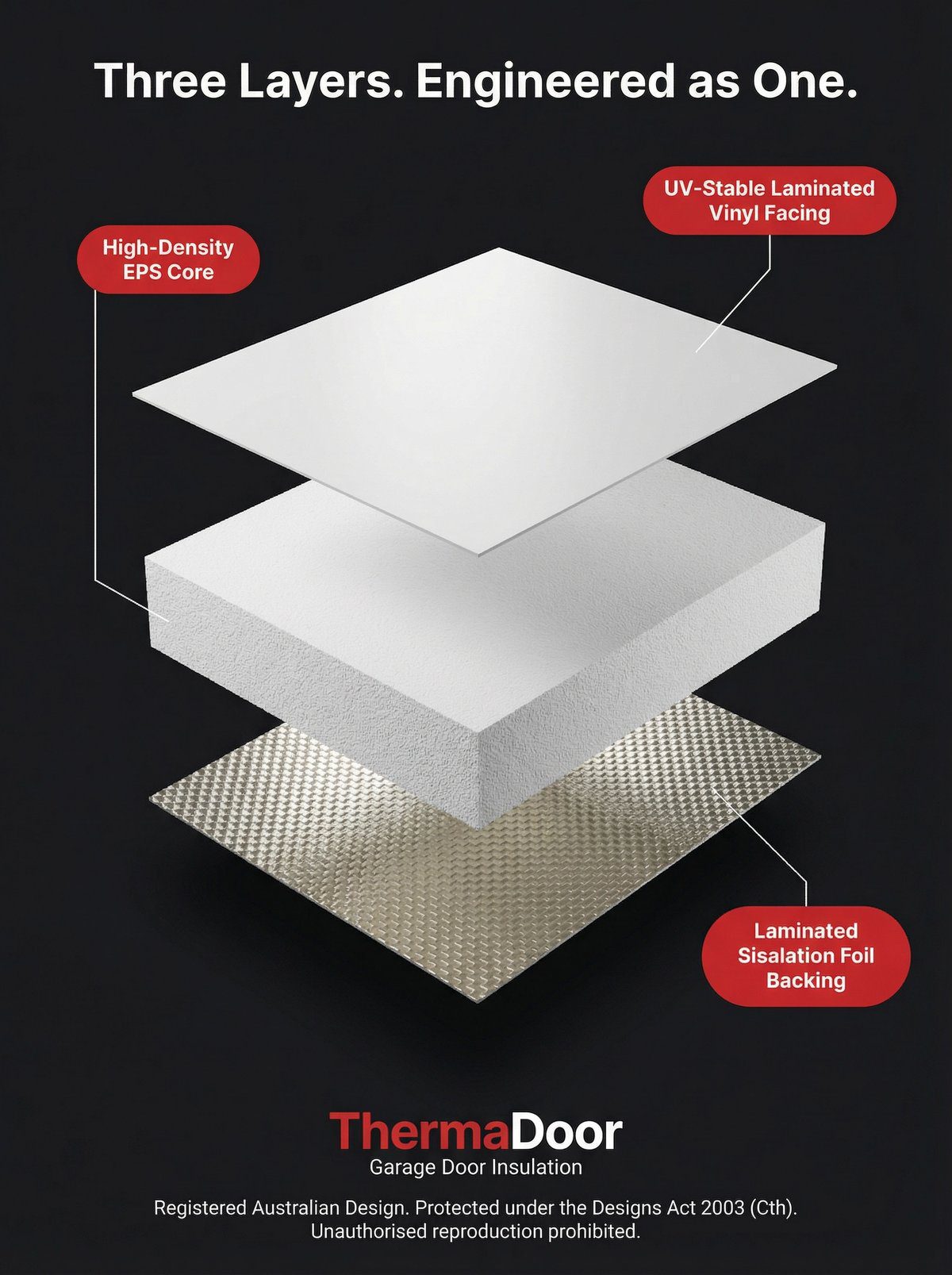
The high-density EPS core slows conducted heat transfer in both summer and winter. The sisalation foil backing acts as a class 2 vapour barrier. The durable, wipe-clean vinyl finish brightens the space and holds up to everyday use.
 
Whether you are looking to create a more comfortable home gym, reduce the load on your air conditioning, or simply stop the garage from overheating in summer and draining warmth in winter, the first step is getting the right data into your Home Energy Rating.
 
 
Exploded diagram of ThermaDoor garage door insulation panel showing UV-Stable Laminated Vinyl Facing, High-Density EPS Core, and Laminated Sisalation Foil Backing
Three Layers. Engineered as One.

Frequently Asked Questions

Does garage door insulation affect a Home Energy Rating?

The garage door is not automatically included in a Home Energy Rating assessment. However, where the garage is attached to the home or adjoins living areas, it can be relevant to the energy performance discussion. For it to be considered, the assessor needs verified assembly R-value data — not a material-only claim or no data at all.

A material R-value measures the thermal resistance of the insulation panel alone. An assembly R-value accounts for the complete installed door, including the steel skins, hinges, joins, tracks and air gaps that conduct heat through the door. Assembly R-values are more accurate and more useful for energy assessors because they reflect how the door actually performs once installed.

Yes. For new builds and major renovations, ThermaDoor should be identified by name in the plans and specifications before the assessor reviews them. This ensures the correct verified assembly data is part of the documentation from the outset. Ask your builder, designer or architect to include it by name.

Yes. ThermaDoor’s R-values are supported by an independent thermal performance report prepared by James Fricker, F.AIRAH F.IEAust CPEng NER APEC Engineer IntPE(Aus), of Engineers Australia. The report documents verified complete installed garage door assembly R-values of R1.43 winter and R1.39 summer, tested under AS/NZS 4859.1:2018 and AS/NZS 4859.2:2018. The report is available through the ThermaDoor Trade & Industry Hub.

Yes. The Australian Government has launched a dedicated Home Energy Rating pathway for existing homes, designed to help homeowners understand their home’s current performance and identify upgrade opportunities. Where the garage is attached to the home, garage door insulation can be part of that conversation. ThermaDoor’s documented product information gives assessors the data they need to include it.

Your ThermaDoor Installation Options

Ready to get started?

ThermaDoor is available as both a DIY garage door insulation kit and through professional supply-and-install via our authorised distributor network.

Option 1

DIY Installation

Measure your garage door panels, order the correct ThermaDoor kit, and install the insulation yourself using our step-by-step guides. ThermaDoor DIY kits are designed for suitable sectional and tilt garage doors, with no adhesives and no permanent changes to the door.

For a general guide, indicative DIY kit pricing is shown below. 

Door Size Panels Price (from)
Single Door8 panelsFrom $320
Single Door (Large)10 panelsFrom $360
Double Door16 panelsFrom $640
Double Door (Large)20 panelsFrom $720

* Prices include GST. Freight not included — calculated at checkout based on your postcode. No obligation to buy.

Option 2

Supply & Installation

Prefer to leave it to the experts? Our trained distributor network installs ThermaDoor panels professionally across Australia. Send us a photo of your door and we will confirm availability in your area.
 
Professional installation available in most metro and regional areas. Contact us to confirm availability.

*T&C’s apply, not available in all areas. 

References

  1. Australian Government — Home Energy Rating
  2. Department of Climate Change, Energy, the Environment and Water — NatHERS: Nationwide House Energy Rating Scheme
  3. Australian Building Codes Board — National Construction Code 2022
  4. Engineers Australia (James Fricker, F.AIRAH F.IEAust CPEng NER APEC Engineer IntPE(Aus)) — ThermaDoor Thermal Performance Report. Available via the ThermaDoor Trade & Industry Hub
  5. Standards Australia — AS/NZS 4859.1:2018 and AS/NZS 4859.2:2018: Materials for the thermal insulation of buildings. Available via Standards Australia
Picture of Peter Hinton
Peter Hinton

Peter is a licensed builder with over 45 years of experience in the construction industry. In 2012, his expertise in energy efficient construction inspired the invention of ThermaDoor Premium garage door insulation - the original purpose made garage door insulation in Australia.

ThermaDoor is the manufacturer of the products discussed in this article and has a commercial interest in their sale. While every effort has been made to ensure the accuracy of the information presented, readers are encouraged to conduct their own research and consult qualified professionals before making purchasing decisions. All R-values cited are independently verified assembly R-values under AS/NZS 4859.1/.2:2018.
ThermaDoor Installation

Let our experts handle installation for you
Or Ask Us A Question

Call, text, or send an enquiry below to see if we have an installer in your area.

Make an Enquiry